
Apr 07, 2026 PK0-005 Exam Crack Test Engine Dumps Training With 448 Questions
Obtain the PK0-005 PDF Dumps Get 100% Outcomes Exam Questions For You To Pass
CompTIA PK0-005: CompTIA Project+ Certification is a globally recognized certification program that validates an individual's knowledge and skills in project management. CompTIA Project+ Certification Exam certification is designed for professionals who want to pursue a career in project management or those who are already working in this field and want to enhance their skills. CompTIA Project+ Certification Exam certification is vendor-neutral, which means that it is not tied to any specific technology or product.
NEW QUESTION # 242
Which of the following is a typical characteristic of Scrum?
- A. Self-organized team
- B. Low-risk scope
- C. Large teams
- D. Well-defined scope
Answer: A
Explanation:
A self-organized team is a typical characteristic of Scrum, which is an agile framework for managing complex
projects. A self-organized team is a group of motivated and skilled individuals who have the autonomy and
authority to make decisions and collaborate on how to deliver the project goals. A self-organized team does
not rely on a manager or a leader to assign tasks, monitor progress, or resolve issues. Instead, a self-organized
team uses Scrum events, such as daily stand-ups, sprint planning, sprint review, and sprint retrospective, to
coordinate their work, communicate with each other, and inspect and adapt their process and product123.
References = CompTIA Project+ Study Guide: Exam PK0-005, 3rd Edition, Chapter 2: Project
Methodologies, p. 55; Scrum Characteristics - Scrumversity; What is Scrum? | Scrum.org; Characteristics of a
Great Scrum Team | Scrum.org
NEW QUESTION # 243
A project manager, who finished a project some time ago, keeps receiving questions from another project manager who is currently leading a similar project. Which of the following is the most likely cause of this situation?
- A. The validation of deliverables is running behind schedule.
- B. The project resources were released ahead of time.
- C. The retrospective session feedback was not communicated properly.
- D. The documentation was not archived as per the PMO standards.
Answer: D
Explanation:
Archiving project documentation is an important process to ensure that the project information is stored, retrieved, and updated in a consistent and efficient manner1. It also helps to meet legal requirements, enable long-term analysis, and support new projects and team members1. If the documentation was not archived as per the PMO standards, it would be difficult for the current project manager to find the relevant documents and learn from the previous project. This would cause the current project manager to keep asking questions to the previous project manager, who may not have all the answers or may not be available. Therefore, the most likely cause of this situation is that the documentation was not archived as per the PMO standards. References = CompTIA Project+ Study Guide: Exam PK0-005, 3rd Edition, Chapter 14: Closing the Project, page 403; How to Archive a Completed Project: A Guide for PMOs, Introduction and Benefits sections.
NEW QUESTION # 244
A PM has identified all the resources involved in a project. The next step is to identify which resources are responsible for which tasks. Which of the following should be used to document this information?
- A. RACI
- B. WBS
- C. RFI
- D. SOW
Answer: A
Explanation:
The RACI (Responsible, Accountable, Consulted, Informed) matrix is used to document which resources are responsible for which tasks. The RACI matrix is a tool that helps to clarify roles and responsibilities on a project. It assigns a level of responsibility to each resource involved in the project. References: CompTIA Project+ Study Guide Section 3.4.
The project manager should use a RACI matrix to document which resources are responsible for which tasks. A RACI matrix is a type of responsibility assignment matrix (RAM) that plots the roles and responsibilities of resources on a project team. RACI stands for Responsible, Accountable, Consulted, and Informed. A RACI matrix can help to clarify who does what on a project, avoid confusion and duplication of work, and improve communication and collaboration among team members.
NEW QUESTION # 245
A project manager requests the testing team to figure out if a website allows multiple users to be signed in at the same time. Which of the following testing methods would be best for the testing team to use?
- A. Regression
- B. Smoke
- C. Unit
- D. Stress
Answer: D
Explanation:
Testing whether a website supports multiple concurrent users signed in at the same time is a question about system behavior under load/concurrency. Among the listed methods, stress testing is the best match because it evaluates how the system performs when pushed toward or beyond normal operating conditions-often involving high volumes of transactions or many simultaneous users/sessions. CompTIA Project+ explicitly includes stress testing as one of the testing cycles/methods candidates should understand in the context of quality and performance management.
The other choices don't align: unit testing validates individual components/functions in isolation, not full end- to-end multi-user session handling; smoke testing is a quick confidence check that basic functionality works after a build/change; and regression testing verifies that existing features still work after changes-useful, but not primarily focused on concurrent-user capacity.
So, to answer the PM's specific question (concurrent sign-ins), the team should run a stress test (often implemented using load-generation tools) to validate session handling, authentication, and resource utilization when many users are logged in simultaneously, and to identify bottlenecks or failure points.
NEW QUESTION # 246
A project team was instructed to refurbish old desktops. The following provides the details of the issues observed: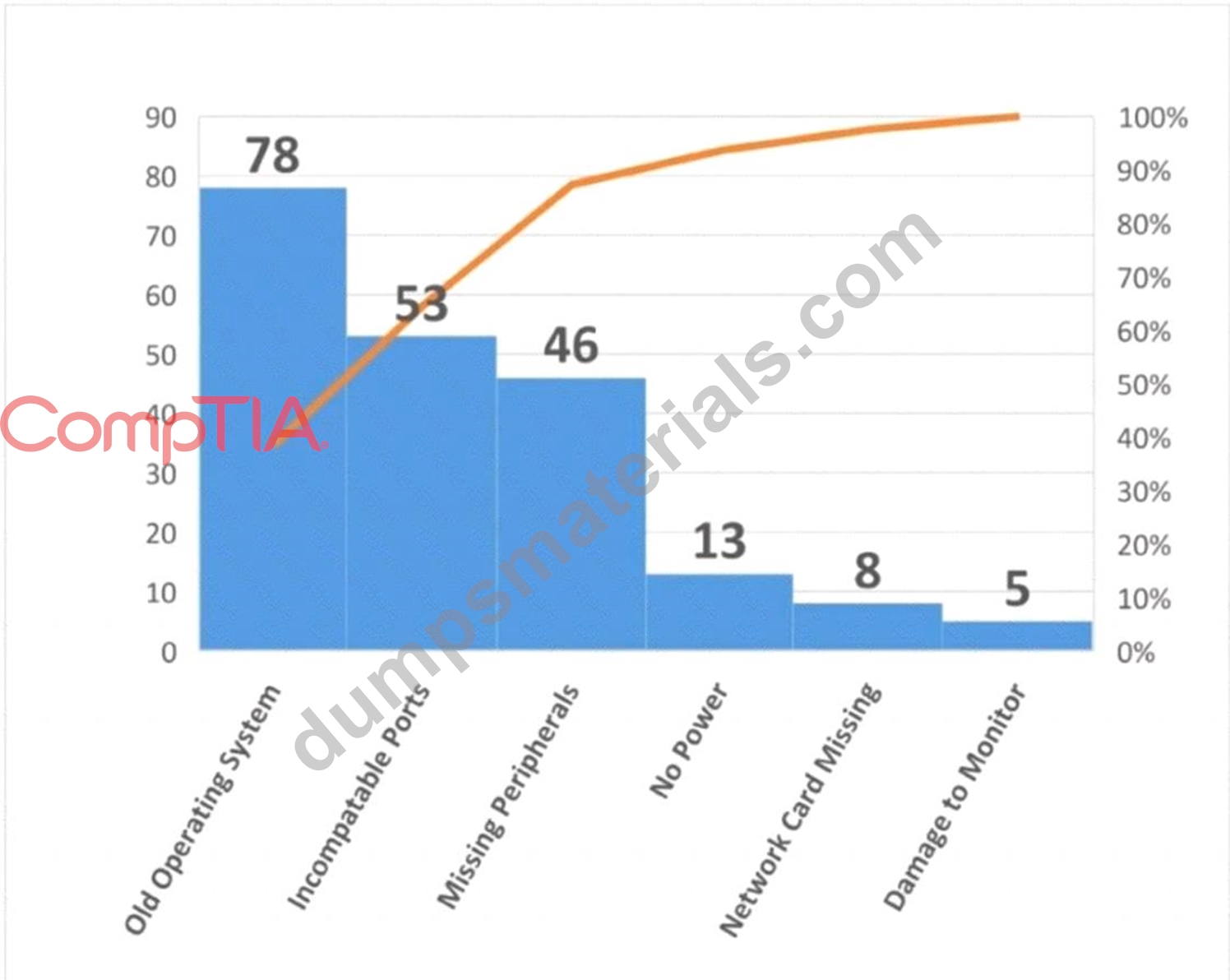
Which of the following issues should be addressed FIRST?
- A. Address each issue as discovered to avoid rework.
- B. Replace missing peripherals because this process can be easy and less costly.
- C. An old operating system issue has the most amount of occurrences.
- D. Damage to the monitor has the highest percentage.
Answer: D
Explanation:
The project manager should address the issue of damage to the monitor first because it has the highest percentage (40%) among the issues observed. This means that it is the most frequent and severe issue that affects the quality and functionality of the refurbished desktops. Addressing this issue first can help to improve customer satisfaction, reduce rework, and avoid waste1
NEW QUESTION # 247
Given the following chart showing committed work (orange) vs. actual work completed (blue) across 10 sprints: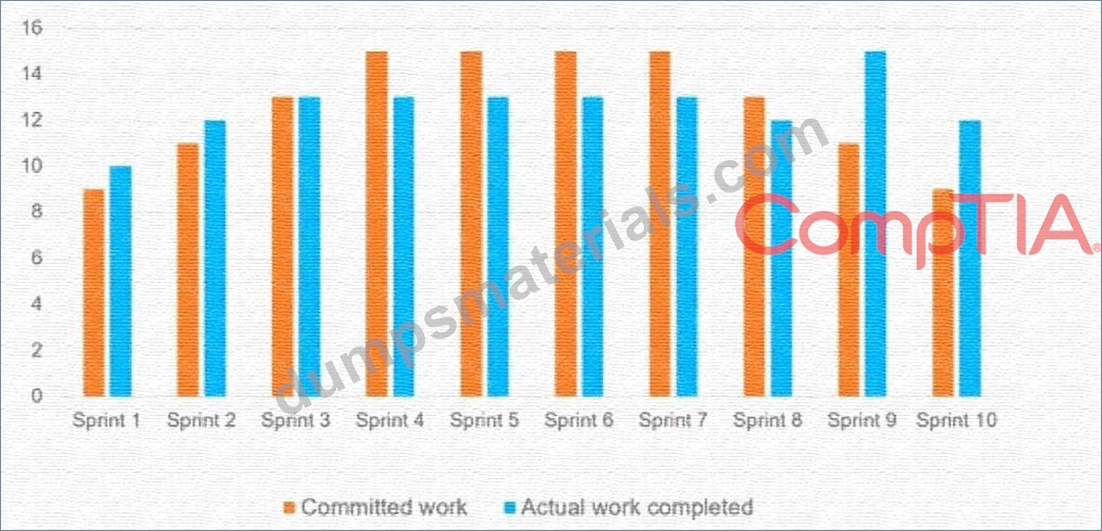
Which of the following best describes the team's performance?
- A. The team needs to adjust the planned work based on results.
- B. The team is doing more work than planned.
- C. The team understands its velocity and is planning in an accurate manner.
- D. The team's velocity is getting better.
Answer: A
Explanation:
To determine the best description of the team's performance, we analyze the chart showing:
Committed work (orange bars): what the team planned to do.
Actual work completed (blue bars): what the team actually accomplished.
Key Observations:
In most sprints (e.g., 1, 3, 4, 5, 6, 8, 10), the actual work is slightly less than the committed work.
In Sprints 9 and 10, the actual work exceeds the committed work.
There's inconsistency in how much work is completed compared to what's committed.
Interpretation:
The team frequently overestimates its capacity. This suggests a misalignment between planning and execution, which indicates that their velocity is not yet well-understood or accurately reflected in sprint planning.
According to the CompTIA Project+ PK0-005 Exam Objectives:
Under Domain 1.2: Compare and contrast Agile vs. Waterfall concepts, understanding team velocity, iteration planning, and the ability to plan based on past performance is key to Agile success.
"Agile teams should use velocity as a guide to improve predictability. Sprint commitments should align with the team's proven delivery capacity."
NEW QUESTION # 248
Which of the following can be used to determine whether a sample product is within an acceptable range?
- A. Fishbone diagram
- B. Scatter diagram
- C. Velocity chart
- D. Control chart
Answer: D
Explanation:
A control chart is a graphical tool that displays the variation of a process over time and compares it to predetermined control limits. It can be used to determine whether a sample product is within an acceptable range by checking if the sample values fall within the upper and lower control limits, which indicate the expected variation of the process. If the sample values are outside the control limits or show a non-random pattern, it indicates that the process is out of control and there may be some assignable causes of variation that need to be investigated and corrected. Reference = CompTIA Project+ Study Guide: Exam PK0-005, 3rd Edition, Chapter 8: Quality Management1; CompTIA Project+ Certification Study Guide, 3rd Edition, Chapter 8: Quality Management2
NEW QUESTION # 249
A project team has just experienced an unexpected event and implemented a work-around. Which of the following documents should be used to record the event? (Select TWO).
- A. Backlog
- B. Change log
- C. Issue log
- D. Defect log
- E. Risk report
- F. Progress report
Answer: B,C
Explanation:
Issue log and change log are documents that should be used to record the event where the project team has just experienced an unexpected event and implemented a work-around. An issue log is a document that tracks and records any issues or problems that arise during a project and how they are resolved. An issue log can help to monitor and control the project performance and quality and prevent any negative impacts on the project objectives and deliverables. A change log is a document that tracks and records any changes or modifications that are made to the project scope, schedule, cost, quality, or resources during a project. A change log can help to document the change request, approval, implementation, and impact of each change and ensure traceability and transparency.
NEW QUESTION # 250
During a brainstorming session, a project team is elaborating on what caused the unexpected crash of the website that the team was developing. Given the following: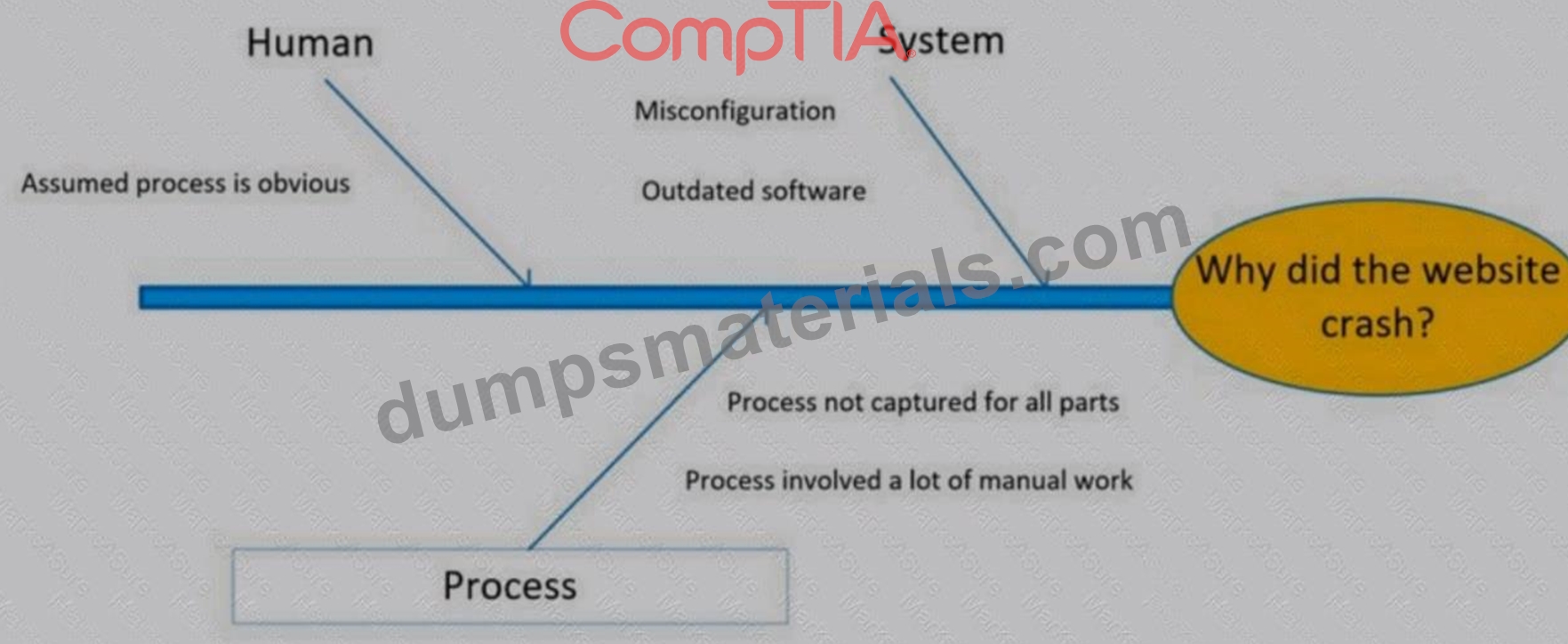
Which of the following was the initial cause of the issue?
- A. Lack of infrastructure
- B. Inadequate memory
- C. Inadequate instructions
- D. Incorrect configuration
Answer: D
Explanation:
Incorrect configuration was the initial cause of the issue that caused the unexpected crash of the website that the team was developing. The diagram given is an example of a fishbone diagram or a cause-and-effect diagram that shows the possible causes of a problem or effect. The diagram has four main categories: people, process, technology, and environment. Each category has subcategories that list specific factors that may contribute to the problem or effect. The diagram shows that incorrect configuration under technology was marked as an initial cause of website crash.
NEW QUESTION # 251
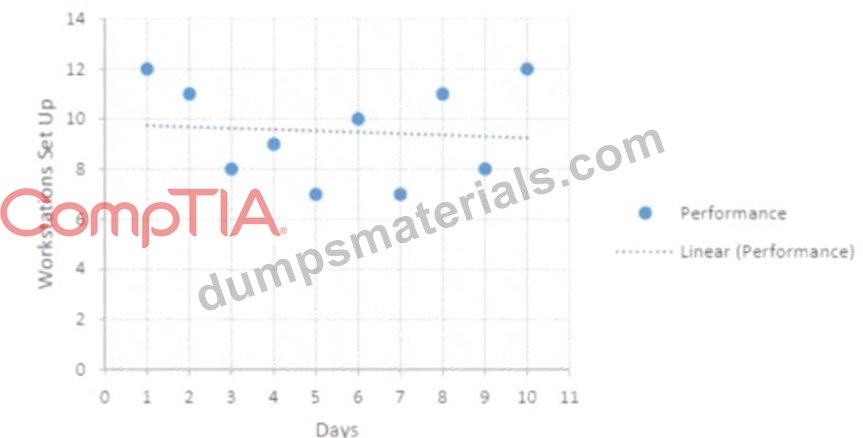
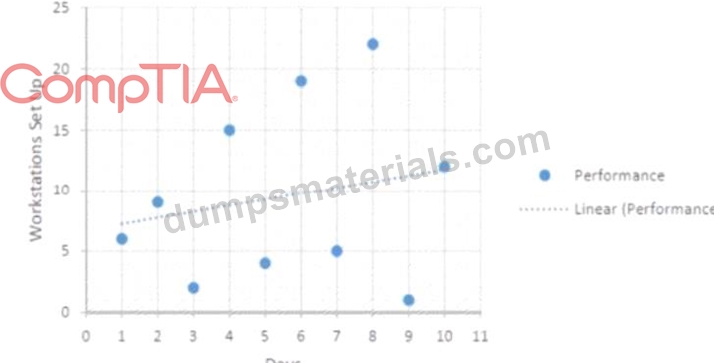
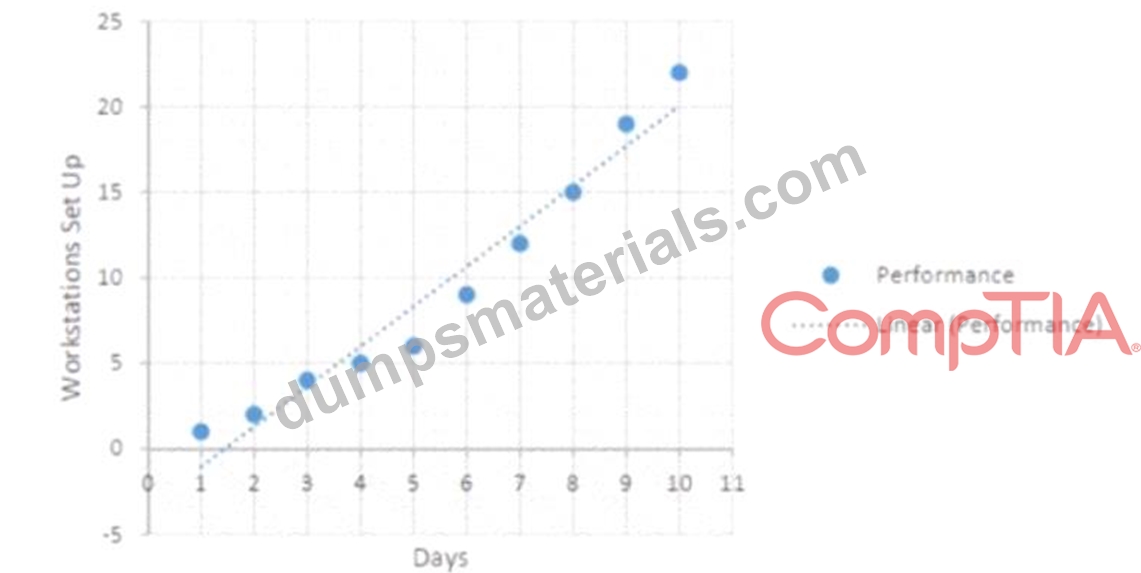
An IT intern was assigned to set up workstations as part of a project. The IT intern was very careful to do the task well and initially referred to notes while performing the task. By the end of the two-week rotation, the IT intern no longer needed the notes and completed more set-ups in less time. Which of the following MOST likely represents the observed relationship in this scenario?
- A.
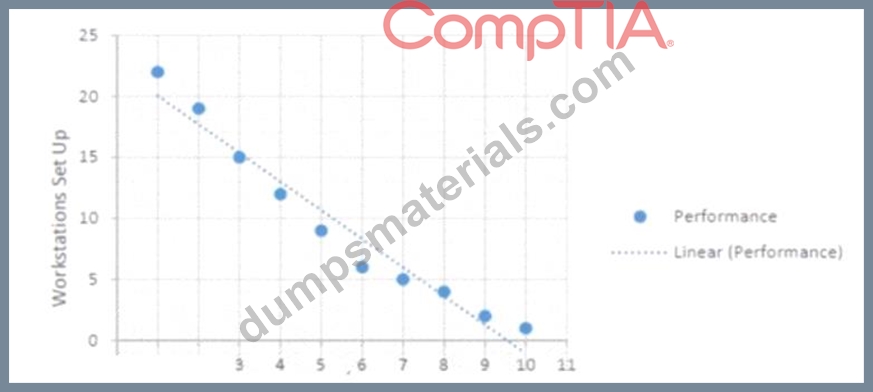
- B.
- C.
- D.
Answer: C
Explanation:
Option C shows a graph that most likely represents the observed relationship in this scenario. The graph shows a learning curve, which is a graphical representation of the relationshipbetween a learner's performance on a task and the number of attempts or time required to complete the task. The learning curve theory proposes that a learner's efficiency in a task improves over time the more the learner performs the task. In this case, the IT intern was able to complete more set-ups in less time as they gained more experience and proficiency over the two-week rotation12
NEW QUESTION # 252
A contractor attended a project meeting that was exclusively for company employees. Which of the following actions should the PM take?
- A. Consult the request for proposal.
- B. Review the meeting cadence.
- C. Reinforce the rules of engagement.
- D. Escalate to vendor management.
Answer: C
Explanation:
The rules of engagement are the guidelines and expectations that define the relationship between the contractor and the company. They may include topics such as communication, confidentiality, access, security, performance, and compliance. The project manager should reinforce the rules of engagement with the contractor to ensure that they understand and respect the boundaries and protocols of the company. This will help to avoid any potential conflicts, misunderstandings, or breaches of contract. Reference = CompTIA Project+ Study Guide: Exam PK0-005, 3rd Edition, Chapter 7: Project Stakeholder Management, p. 239; Contractor Rules of Engagement - Cox Enterprises, p. 1; Legal Considerations for Engaging Contractors | LegalVision
NEW QUESTION # 253
A project manager provided the team with a summary Gantt chart for the project. The team, however, has expressed interest in seeing the sequencing between all of the tasks. Which of the following should the project manager provide?
- A. Fishbone diagram
- B. Burndown chart
- C. Milestone chart
- D. Project network diagram
Answer: D
Explanation:
A Project Network Diagram is a visual representation that displays the sequence of project activities and the dependencies between them. Unlike a Gantt chart, which primarily shows the schedule and durations, a network diagram emphasizes the logical flow and relationships among tasks, making it ideal for understanding task sequencing.Plaky According to the CompTIA Project+ PK0-005 exam objectives, under Domain 3.1: Given a scenario, use the appropriate tools throughout the project life cycle, the project network diagram is identified as a key tool for illustrating task sequencing and dependencies.
NEW QUESTION # 254
As a result of an approved change, the project manager updates the project plan with the newest project end date. Which of the following change control processes should the project manager complete NEXT?
- A. Conduct an impact assessment.
- B. Implement the change.
- C. Document the request in the change control log.
- D. Communicate the change deployment.
Answer: D
Explanation:
Explanation
The project manager should communicate the change deployment next after updating the project plan with the newest project end date as a result of an approved change. Communicating the change deployment involves informing all relevant parties about when and how the change will be implemented and what are the expected outcomes and benefits.Communicating the change deployment can help to ensure alignment, readiness, and support for the change and avoid any confusion or resistance.
NEW QUESTION # 255
A few weeks before a project is scheduled to be completed, the client asks to add a new feature to the product
that is being developed. The project manager analyzes the project schedule and determines the feature can be
implemented quite easily without affecting the completion date. Which of the following should the project
manager do first?
- A. Document the change recommendations.
- B. Review the requested change.
- C. Escalate the change to the CCB.
- D. Validate the implementation of the requested change.
Answer: B
Explanation:
The project manager should review the requested change first to assess its impact, feasibility, and alignment
with the project objectives and scope. Reviewing the change will help the project manager to determine if the
change is necessary, beneficial, and acceptable to the stakeholders. The project manager should also consider
the risks, costs, and quality implications of the change before proceeding to the next steps of the change
management process123. References = CompTIA Project+ Study Guide: Exam PK0-005, 3rd Edition, Chapter
9: Project Change Management, p. 323; 5 Steps in the Change Management Process | HBS Online; 8 Steps for
an Effective Change Management Process - Smartsheet
NEW QUESTION # 256
One of the key steps in controlling changes lo software is obtaining approval. Which of the following
statements best describes the reason for this key objective?
- A. To confirm that the software is a business priority
- B. To send the appropriate customer notifications
- C. To ensure adequate resources are in place to implement the change
- D. To avoid a negative impact on other software functionalities
Answer: D
Explanation:
Obtaining approval for changes to software is crucial to ensure that the changes do not negatively impact other
functionalities of the software. Approval processes typically involve a review that assesses the potential
impacts of the change, which helps in mitigating risks associated with the change.
References = The answer is based on standard project management practices and the typical use of change
control processes in software development. For detailed information, please refer to the CompTIA Project+
Study Guide and other official CompTIA resources.
NEW QUESTION # 257
During a gate review meeting, the deliverable was rejected by the customer.
INSTRUCTIONS
Review the dashboard.
* Part 1: Drag and drop each task, placing them in the correct order based on the project change control process.
* Part 2: Select the proper document(s) to be updated.
If at any time you would like to bring back the initial state of the simulation, please click the Reset All button.
Part 1: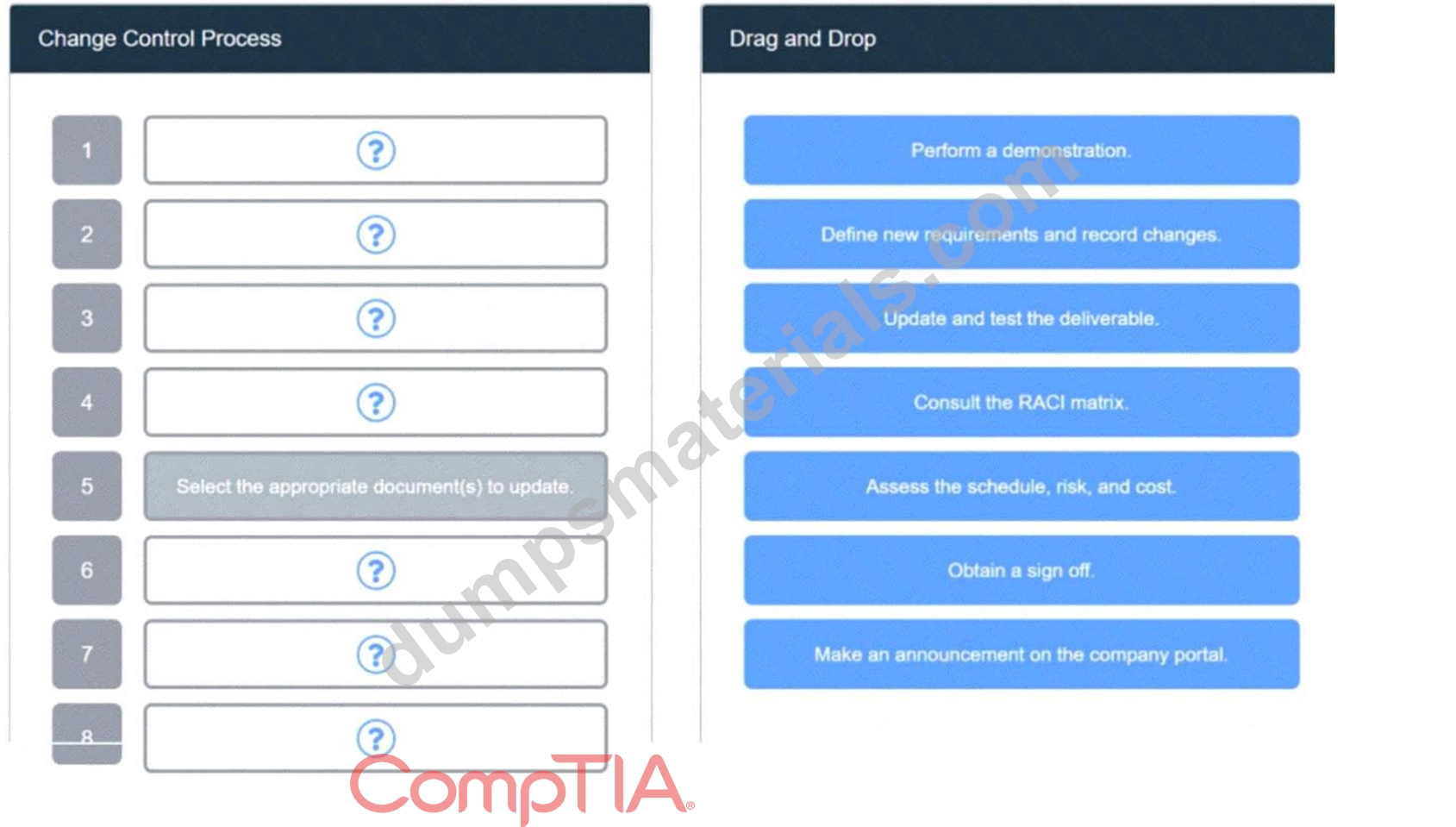
Part 2: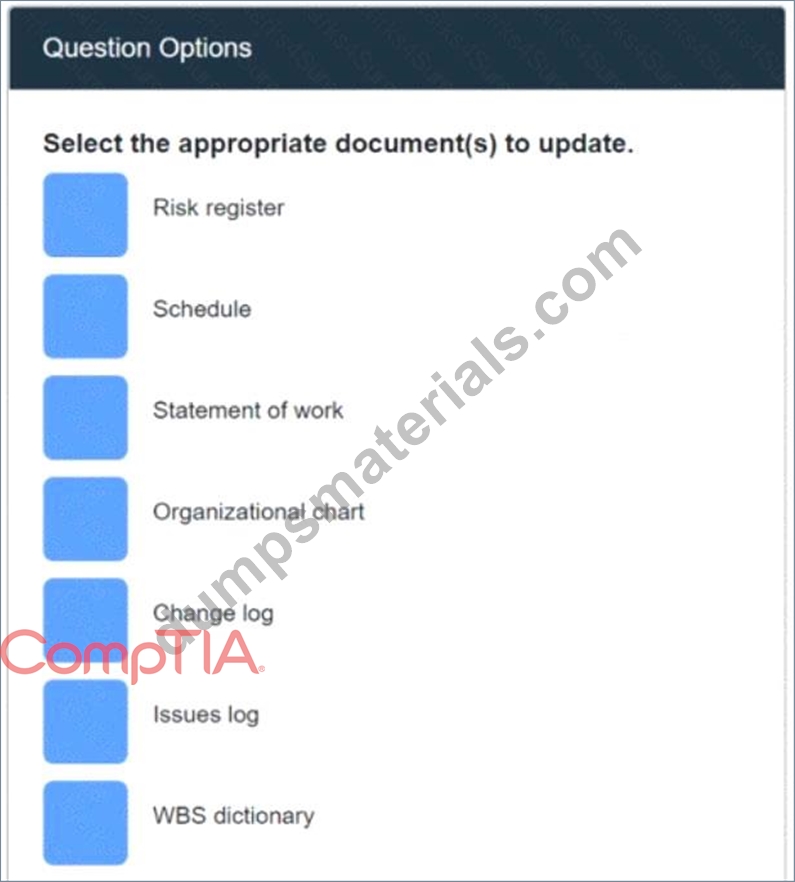
Answer:
Explanation:
Part 1:
Change Control Process:
* Consult the RACI matrix.
* Define new requirements and record changes.
* Assess the schedule, risk, and cost.
* Perform a demonstration.
* Obtain a sign off.
* Update and test the deliverable.
* Make an announcement on the company portal.
The change control process is a sequence of steps that helps to manage and document any changes or modifications to a project scope, schedule, cost, quality, or resources. The change control process typically involves the following steps:
* Consult the RACI matrix. A RACI matrix is a tool that defines and clarifies the roles and responsibilities of each team member for each task or activity in a project. RACI stands for responsible, accountable, consulted, and informed. Consulting the RACI matrix can help to identify who needs to be involved or informed about the change request and how to communicate with them.
* Define new requirements and record changes. The new requirements and changes are the details of what needs to be modified or added to the project deliverables or objectives based on the customer feedback or request. Defining and recording the new requirements and changes can help to communicate and justify the need and rationale for the change and its implications on the project scope and quality.
* Assess the schedule, risk, and cost. The schedule, risk, and cost are the aspects of the project that may be affected by the change request. Assessing the schedule, risk, and cost can help to determine the impact and feasibility of the change and identify any possible alternatives or corrective actions to minimize or avoid its negative effects.
* Perform a demonstration. A demonstration is a presentation or show of how the modified or updated deliverable works or meets the customer expectations or requirements. Performing a demonstration can help to validate and verify that the change request has been implemented correctly and effectively and to obtain feedback or approval from the customer or stakeholders.
* Obtain a sign off. A sign off is a formal acceptance and approval of the change request and its deliverables from the customer or stakeholders. Obtaining a sign off can help to confirm that the change request has been completed successfully and satisfactorily and to close the change control process.
* Update and test the deliverable. The deliverable is the product or service that is produced or provided by the project. Updating and testing the deliverable can help to ensure that it meets the quality standards and criteria and that it works as expected after implementing the change request.
* Make an announcement on the company portal. The company portal is a platform or channel that allows internal communication and collaboration among employees within an organization. Making an announcement on the company portal can help to inform and update other team members or departments about the change request and its outcomes and to share any lessons learned or best practices from the change control process.
Part2:
* Risk register: A risk register is a document that identifies, analyzes, and records the potential risks or uncertainties that may affect a project. Updating the risk register can help to capture any new or modified risks that may arise from the change request and to plan and implement appropriate risk responses.
* Schedule: A schedule is a document that shows the planned start and end dates, durations, dependencies, and progress of each task or activity in a project. Updating the schedule can help to reflect any changes or adjustments to the project timeline or milestones that may result from the change request and to monitor and control the project performance and delivery.
* Statement of work: A statement of work (SOW) is a document that defines the scope, deliverables, schedule, and terms and conditions of a project or contract. Updating the SOW can help to document any changes or additions to the project scope or deliverables that may be requested or agreed upon by the customer or stakeholders and to ensure alignment and agreement on what needs to be done and how it will be done.
* Change log: A change log is a document that tracks and records any changes or modifications that are made to the project scope, schedule, cost, quality, or resources during a project. Updating the change log can help to document the change request, approval, implementation, and impact of each change and ensure traceability and transparency.
NEW QUESTION # 258
A project team is working on a document to precisely describe the success criteria that should be fulfilled by a product. Which of the following documents is the team preparing?
- A. Work breakdown structure
- B. Contract obligations
- C. Project scope
- D. Quality plan
Answer: C
Explanation:
The project scope is the document that defines and describes the project objectives, deliverables, requirements, boundaries, assumptions, and constraints. It also includes the success criteria that should be fulfilled by the product or service to meet the stakeholder expectations and the business case. The success criteria are the measurable standards that indicate whether the project has achieved its intended results. The other options are not correct because:
A quality plan is the document that defines and describes the quality standards, policies, procedures, tools, and techniques that will be applied to the project to ensure that the deliverables meet the requirements and the success criteria.
Contract obligations are the terms and conditions that bind the parties involved in a contractual agreement, such as the project manager, the customer, the sponsor, and the vendor. Contract obligations specify the roles, responsibilities, deliverables, payments, and penalties of each party.
A work breakdown structure (WBS) is a graphical representation of the project scope that breaks down the deliverables into smaller and manageable components. A WBS shows the hierarchy and relationship of the project elements, but does not include the success criteria. References = CompTIA Project+ Study Guide:
Exam PK0-005, 3rd Edition, Chapter 6: Planning Projects, Part 2 (Scope, Quality, and Risk), pages 175-
179; CompTIA Project+ Certification Exam Objectives, Domain 2: Project Planning, Objective 2.1: Given a scenario, create a project charter and project management plan.
NEW QUESTION # 259
A project team evaluated the performance of a new reporting system and the quantity of queries to be processed during predetermined time stamps.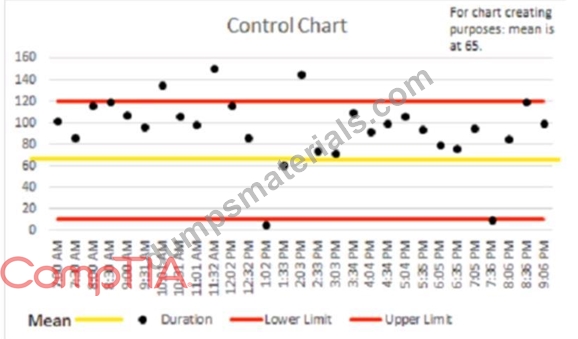
Which of the following is the current status of the process?
- A. The goal should be adjusted since most of the data points are close to the lower limit.
- B. The process is out of control and should be revised.
- C. Based on the rule of seven, the process is under control
- D. The amount of data is insufficient to determine if quality is low.
Answer: B
Explanation:
The process is out of control and should be revised. The project manager can use the rule of seven to determine the status of the process based on the control chart. The rule of seven states that if seven or more consecutive measurements fall on one side of the mean that there's an assignable cause that needs investigation. In this case, the last seven data points are all below the mean, which indicates that the process is out of control and in need of adjustment12
NEW QUESTION # 260
During a status meeting, the development team reviews work and finds an unforeseen dependency on one of
the critical project activities. As a result, the project will most likely be delayed. Which of the following
actions should the project manager MOST likely perform?
- A. Ask the development team to fast-track upcoming activities.
- B. Work with the project scheduler to update the project timeline.
- C. Communicate to the stakeholders about the updated timeline.
- D. Add two resources so the critical activities will finish on time.
Answer: B
Explanation:
Work with the project scheduler to update the project timeline. The project manager should work with the
project scheduler to update the project timeline after finding an unforeseen dependency on one of the critical
project activities that will most likely cause a delay. The project scheduler is a person or a tool that helps plan,
schedule, monitor, and control the project activities and resources. The project scheduler can help the project
manager to assess the impact of the dependency on the project schedule and identify any possible ways to
mitigate or resolve it. The project scheduler can also help to update the project timeline with the revised dates
and durations of the project activities and communicate them to the relevant stakeholders.
NEW QUESTION # 261
After a weekly status meeting, a project manager needs to prepare and distribute a document with a summary of all the topics discussed, agreements, and next steps. Which of the following documents should the project manager prepare?
- A. Memorandum
- B. Minutes
- C. Project presentation
- D. Issue log
Answer: B
Explanation:
The correct document is meeting minutes. Minutes capture what was discussed, key decisions/agreements made, action items/next steps (often with owners and due dates), and any follow-up items. CompTIA Project+ includes meeting management practices and emphasizes documenting outcomes and action items so the team has a shared, traceable record-especially important in recurring status meetings where decisions and commitments accumulate over time. () A project presentation is typically used to brief stakeholders visually and isn't the standard artifact for recording agreements and action items from a weekly meeting. A memorandum can communicate information formally, but it is not the specific document type for "summary of topics discussed, agreements, and next steps" in a meeting context. An issue log is for tracking issues (problems that have occurred), not for documenting the full meeting discussion and decisions.
Well-written minutes reduce confusion, align stakeholders, and create accountability. They also support change control and escalation because they document what was agreed and when. Therefore, for a weekly status meeting summary including agreements and next steps, the PM should prepare and distribute minutes. ()
NEW QUESTION # 262
A project team member has been interacting on personal social media instead of performing assigned tasks.
This behavior is explicitly forbidden in the team charter.
Which of the following actions should the project manager take?
- A. Address the issue at the next team meeting to allow other team members to provide feedback
- B. Allow the team member to continue to use personal social media during times of productivity
- C. Conduct an informal meeting with the team member to discuss work assignments and obstacles
- D. Post a copy of the team charter on the file-sharing platform and encourage interactive discussions
Answer: C
Explanation:
Comprehensive and Detailed Step-by-Step Explanation:When addressing performance issues, the best approach is to have an informal, one-on-one discussion with the employee to understand the reason behind their behavior. This approach helps identify any challenges they may be facing and allows for a resolution without creating unnecessary tension within the team.
NEW QUESTION # 263
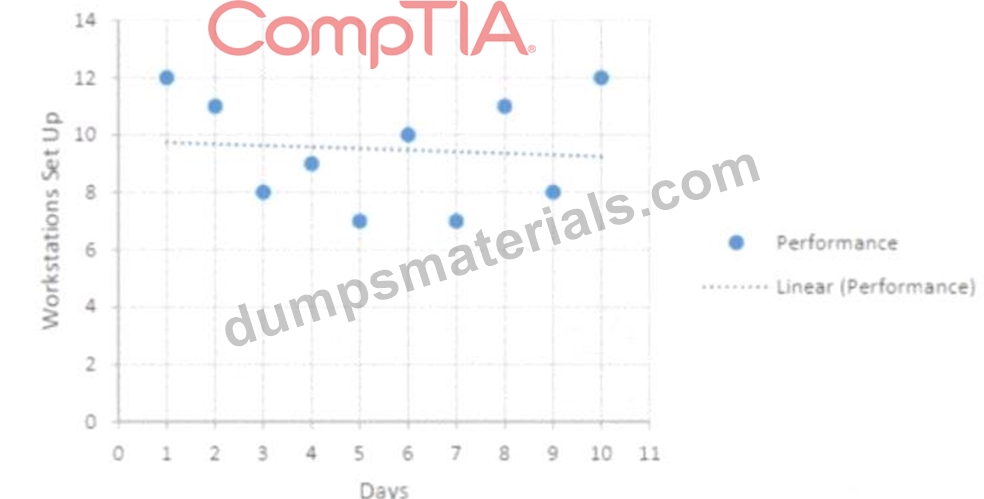
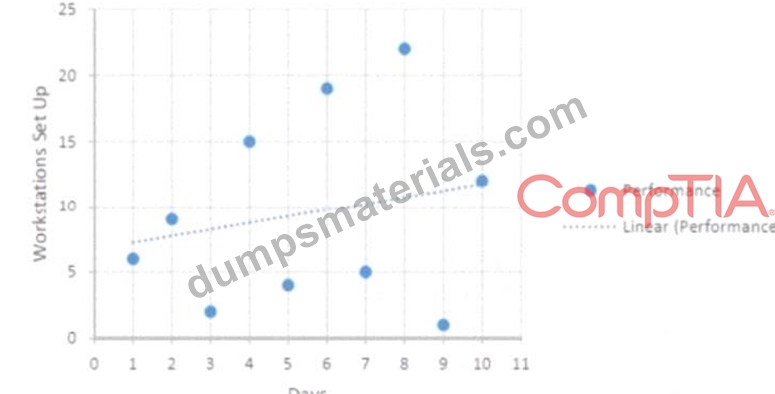
An IT intern was assigned to set up workstations as part of a project. The IT intern was very careful to do the task well and initially referred to notes while performing the task. By the end of the two-week rotation, the IT intern no longer needed the notes and completed more set-ups in less time. Which of the following MOST likely represents the observed relationship in this scenario?
- A.
- B.

- C.
- D.
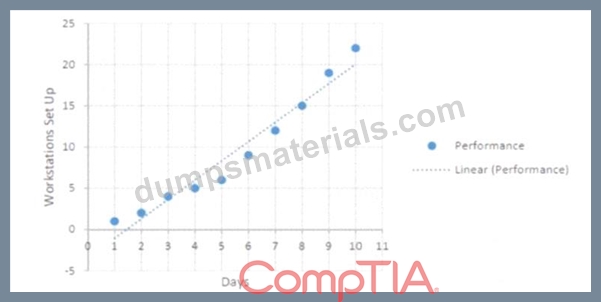
Answer: C
Explanation:
Option C shows a graph that most likely represents the observed relationship in this scenario. The graph shows a learning curve, which is a graphical representation of the relationship between a learner's performance on a task and the number of attempts or time required to complete the task. The learning curve theory proposes that a learner's efficiency in a task improves over time the more the learner performs the task. In this case, the IT intern was able to complete more set-ups in less time as they gained more experience and proficiency over the two-week rotation12
NEW QUESTION # 264
The project team determines that software installation can only begin after the desktops have been installed and can be powered on. Which of the following dependencies does this represent?
- A. Mandatory
- B. Discretionary
- C. External
- D. Internal
Answer: A
Explanation:
Explanation
The dependency between software installation and desktop installation is a mandatory dependency. A mandatory dependency is a type of dependency that is inherent in the nature or logic of the work and cannot be avoided or changed. It is also known as a hard dependency or a hard logic dependency. A mandatory dependency means that one task must be completed before another task can start or finish. For example, software installation can only start after desktop installation is finished5 The dependency between desktop installation and software installation represents a mandatory dependency. A mandatory dependency is a type of task dependency that is inherent in the nature of the work being performed.
In this case, software installation cannot begin until desktops are installed and powered on, and therefore, the dependency is mandatory. References: CompTIA Project+ Study Guide, Chapter 3: Project Integration Management, Objective 3.1: Identify the project management processes and the interactions between them.
NEW QUESTION # 265
......
PK0-005 Exam Dumps Contains FREE Real Quesions from the Actual Exam: https://braindumps2go.dumpsmaterials.com/PK0-005-real-torrent.html
