
ARA-C01 Exam Dumps Free Test Engine Verified By SnowPro Advanced Certification Certified Experts
Use Real Snowflake Achieve the ARA-C01 Dumps - 100% Exam Passing Guarantee
Snowflake ARA-C01 exam is a challenging exam that requires a significant amount of preparation and study. Candidates should have experience working with Snowflake and should be familiar with Snowflake best practices and implementation strategies. ARA-C01 exam consists of multiple-choice questions and scenario-based questions that test the candidate's ability to design and implement Snowflake solutions. Candidates who pass the exam will earn the SnowPro Advanced Architect certification, which is a highly respected certification in the data warehousing industry.
Snowflake ARA-C01 (SnowPro Advanced Architect Certification) Exam is a prestigious certification program for professionals who work with Snowflake. It measures the candidate's ability to design and implement complex Snowflake solutions in a variety of scenarios. SnowPro Advanced Architect Certification certification program is designed to validate the candidate's knowledge of data warehousing, data modeling, ETL, security, and performance optimization best practices in a Snowflake environment. Passing the exam is a great way to demonstrate your expertise in Snowflake's advanced concepts and techniques and differentiate yourself in the competitive data analytics industry.
NEW QUESTION # 60
You have written a procedure and a function in snowflake.
How do you find your procedures and functions in snowflake?
- A. SHOW ALL PROCEDURES AND FUNCTIONS
- B. SHOW PROCEDURES;
- C. SHOW FUNCTIONS;
- D. SHOW PROCEDURES, FUNCTIONS
Answer: C
NEW QUESTION # 61
What are purposes for creating a storage integration? (Choose three.)
- A. Create private VPC endpoints that allow direct, secure connectivity between VPCs without traversing the public internet.
- B. Support multiple external stages using one single Snowflake object.
- C. Manage credentials from multiple cloud providers in one single Snowflake object.
- D. Control access to Snowflake data using a master encryption key that is maintained in the cloud provider's key management service.
- E. Avoid supplying credentials when creating a stage or when loading or unloading data.
- F. Store a generated identity and access management (IAM) entity for an external cloud provider regardless of the cloud provider that hosts the Snowflake account.
Answer: B,E,F
Explanation:
A storage integration is a Snowflake object that stores a generated identity and access management (IAM) entity for an external cloud provider, such as Amazon S3, Google Cloud Storage, or Microsoft Azure Blob Storage. This integration allows Snowflake to read data from and write data to an external storage location referenced in an external stage1.
One purpose of creating a storage integration is to support multiple external stages using one single Snowflake object. An integration can list buckets (and optional paths) that limit the locations users can specify when creating external stages that use the integration. Note that many external stage objects can reference different buckets and paths and use the same storage integration for authentication1. Therefore, option C is correct.
Another purpose of creating a storage integration is to avoid supplying credentials when creating a stage or when loading or unloading data. Integrations are named, first-class Snowflake objects that avoid the need for passing explicit cloud provider credentials such as secret keys or access tokens. Integration objects store an IAM user ID, and an administrator in your organization grants the IAM user permissions in the cloud provider account1. Therefore, option D is correct.
A third purpose of creating a storage integration is to store a generated IAM entity for an external cloud provider regardless of the cloud provider that hosts the Snowflake account. For example, you can create a storage integration for Amazon S3 even if your Snowflake account is hosted on Azure or Google Cloud Platform. This allows you to access data across different cloud platforms using Snowflake1. Therefore, option B is correct.
Option A is incorrect, because creating a storage integration does not control access to Snowflake data using a master encryption key. Snowflake encrypts all data using a hierarchical key model, and the master encryption key is managed by Snowflake or by the customer using a cloud provider's key management service. This is independent of the storage integration feature2.
Option E is incorrect, because creating a storage integration does not create private VPC endpoints. Private VPC endpoints are a network configuration option that allow direct, secure connectivity between VPCs without traversing the public internet. This is also independent of the storage integration feature3.
Option F is incorrect, because creating a storage integration does not manage credentials from multiple cloud providers in one single Snowflake object. A storage integration is specific to one cloud provider, and you need to create separate integrations for each cloud provider you want to access4.
NEW QUESTION # 62
An Architect needs to design a data unloading strategy for Snowflake, that will be used with the COPY INTO
<location> command.
Which configuration is valid?
- A. Location of files: Azure ADLS
. File formats: JSON, XML, Avro, Parquet, ORC
. Compression: bzip2
. Encryption: User-supplied key - B. Location of files: Amazon S3
. File formats: CSV, JSON
. File encoding: Latin-1 (ISO-8859)
. Encryption: 128-bit - C. Location of files: Google Cloud Storage
. File formats: Parquet
. File encoding: UTF-8
Compression: gzip - D. Location of files: Snowflake internal location
. File formats: CSV, XML
. File encoding: UTF-8
. Encryption: 128-bit
Answer: C
NEW QUESTION # 63
Consider the following COPY command which is loading data with CSV format into a Snowflake table from an internal stage through a data transformation query.
This command results in the following error:
SQL compilation error: invalid parameter 'validation_mode'
Assuming the syntax is correct, what is the cause of this error?
- A. The value return_all_errors of the option VALIDATION_MODE is causing a compilation error.
- B. The VALIDATION_MODE parameter does not support COPY statements with CSV file formats.
- C. The VALIDATION_MODE parameter does not support COPY statements that transform data during a load.
- D. The VALIDATION_MODE parameter supports COPY statements that load data from external stages only.
Answer: C
Explanation:
Explanation
* The VALIDATION_MODE parameter is used to specify the behavior of the COPY statement when loading data into a table. It is used to specify whether the COPY statement should return an error if any of the rows in the file are invalid or if it should continue loading the valid rows. The VALIDATION_MODE parameter is only supported for COPY statements that load data from external stages1.
* The query in the question uses a data transformation query to load data from an internal stage. A data transformation query is a query that transforms the data during the load process, such as parsing JSON or XML data, applying functions, or joining with other tables2.
* According to the documentation, VALIDATION_MODE does not support COPY statements that transform data during a load. If the parameter is specified, the COPY statement returns an error1.
Therefore, option C is the correct answer.
References: : COPY INTO <table> : Transforming Data During a Load
NEW QUESTION # 64
Following objects can be cloned in snowflake
- A. Transient table
- B. Permanent table
- C. External tables
- D. Temporary table
- E. Internal stages
Answer: A,B,D
NEW QUESTION # 65
An Architect has designed a data pipeline that Is receiving small CSV files from multiple sources. All of the files are landing in one location. Specific files are filtered for loading into Snowflake tables using the copy command. The loading performance is poor.
What changes can be made to Improve the data loading performance?
- A. Create a multi-cluster warehouse and merge smaller files to create bigger files.
- B. Change the file format from CSV to JSON.
- C. Increase the size of the virtual warehouse.
- D. Create a specific storage landing bucket to avoid file scanning.
Answer: A
Explanation:
According to the Snowflake documentation, the data loading performance can be improved by following some best practices and guidelines for preparing and staging the data files. One of the recommendations is to aim for data files that are roughly 100-250 MB (or larger) in size compressed, as this will optimize the number of parallel operations for a load. Smaller files should be aggregated and larger files should be split to achieve this size range. Another recommendation is to use a multi-cluster warehouse for loading, as this will allow for scaling up or out the compute resources depending on the load demand. A single-cluster warehouse may not be able to handle the load concurrency and throughput efficiently. Therefore, by creating a multi-cluster warehouse and merging smaller files to create bigger files, the data loading performance can be improved. References:
* Data Loading Considerations
* Preparing Your Data Files
* Planning a Data Load
NEW QUESTION # 66
Data is being imported and stored as JSON in a VARIANT column. Query performance was fine, but most recently, poor query performance has been reported.
What could be causing this?
- A. The recent data imports contained fewer fields than usual.
- B. There were variations in string lengths for the JSON values in the recent data imports.
- C. The order of the keys in the JSON was changed.
- D. There were JSON nulls in the recent data imports.
Answer: B,C
Explanation:
Data is being imported and stored as JSON in a VARIANT column. Query performance was fine, but most recently, poor query performance has been reported. This could be caused by the following factors:
* The order of the keys in the JSON was changed. Snowflake stores semi-structured data internally in a column-like structure for the most common elements, and the remainder in a leftovers-like column. The order of the keys in the JSON affects how Snowflake determines the common elements and how it optimizes the query performance. If the order of the keys in the JSON was changed, Snowflake might have to re-parse the data and re-organize the internal storage, which could result in slower query performance.
* There were variations in string lengths for the JSON values in the recent data imports. Non-native values, such as dates and timestamps, are stored as strings when loaded into a VARIANT column.
Operations on these values could be slower and also consume more space than when stored in a relational column with the corresponding data type. If there were variations in string lengths for the
* JSON values in the recent data imports, Snowflake might have to allocate more space and perform more conversions, which could also result in slower query performance.
The other options are not valid causes for poor query performance:
* There were JSON nulls in the recent data imports. Snowflake supports two types of null values in semi-structured data: SQL NULL and JSON null. SQL NULL means the value is missing or unknown, while JSON null means the value is explicitly set to null. Snowflake can distinguish between these two types of null values and handle them accordingly. Having JSON nulls in the recent data imports should not affect the query performance significantly.
* The recent data imports contained fewer fields than usual. Snowflake can handle semi-structured data with varying schemas and fields. Having fewer fields than usual in the recent data imports should not affect the query performance significantly, as Snowflake can still optimize the data ingestion and query execution based on the existing fields.
References:
* Considerations for Semi-structured Data Stored in VARIANT
* Snowflake Architect Training
* Snowflake query performance on unique element in variant column
* Snowflake variant performance
NEW QUESTION # 67
An Architect is designing a file ingestion recovery solution. The project will use an internal named stage for file storage. Currently, in the case of an ingestion failure, the Operations team must manually download the failed file and check for errors.
Which downloading method should the Architect recommend that requires the LEAST amount of operational overhead?
- A. Use the get command in SnowSQL to retrieve the file.
- B. Use the Snowflake API endpoint and download the file.
- C. Use the get command in Snowsight to retrieve the file.
- D. Use the Snowflake Connector for Python, connect to remote storage and download the file.
Answer: A
Explanation:
The get command in SnowSQL is a convenient way to download files from an internal stage to a local directory. The get command can be used in interactive mode or in a script, and it supports wildcards and parallel downloads. The get command also allows specifying the overwrite option, which determines how to handle existing files with the same name2 The Snowflake Connector for Python, the Snowflake API endpoint, and the get command in Snowsight are not recommended methods for downloading files from an internal stage, because they require more operational overhead than the get command in SnowSQL. The Snowflake Connector for Python and the Snowflake API endpoint require writing and maintaining code to handle the connection, authentication, and file transfer. The get command in Snowsight requires using the web interface and manually selecting the files to download34 Reference:
1: SnowPro Advanced: Architect | Study Guide
2: Snowflake Documentation | Using the GET Command
3: Snowflake Documentation | Using the Snowflake Connector for Python
4: Snowflake Documentation | Using the Snowflake API
: Snowflake Documentation | Using the GET Command in Snowsight
: SnowPro Advanced: Architect | Study Guide
: Using the GET Command
: Using the Snowflake Connector for Python
: Using the Snowflake API
: [Using the GET Command in Snowsight]
NEW QUESTION # 68
When using the copy into <table> command with the CSV file format, how does the match_by_column_name parameter behave?
- A. It expects a header to be present in the CSV file, which is matched to a case-sensitive table column name.
- B. The command will return an error.
- C. The command will return a warning stating that the file has unmatched columns.
- D. The parameter will be ignored.
Answer: D
Explanation:
Option B is the best design to meet the requirements because it uses Snowpipe to ingest the data continuously and efficiently as new records arrive in the object storage, leveraging event notifications. Snowpipe is a service that automates the loading of data from external sources into Snowflake tables1. It also uses streams and tasks to orchestrate transformations on the ingested data. Streams are objects that store the change history of a table, and tasks are objects that execute SQL statements on a schedule or when triggered by another task2.
Option B also uses an external function to do model inference with Amazon Comprehend and write the final records to a Snowflake table. An external function is a user-defined function that calls an external API, such as Amazon Comprehend, to perform computations that are not natively supported by Snowflake3. Finally, option B uses the Snowflake Marketplace to make the de-identified final data set available publicly for advertising companies who use different cloud providers in different regions. The Snowflake Marketplace is a platform that enables data providers to list and share their data sets with data consumers, regardless of the cloud platform or region they use4.
Option A is not the best design because it uses copy into to ingest the data, which is not as efficient and continuous as Snowpipe. Copy into is a SQL command that loads data from files into a table in a single transaction. It also exports the data into Amazon S3 to do model inference with Amazon Comprehend, which adds an extra step and increases the operational complexity and maintenance of the infrastructure.
Option C is not the best design because it uses Amazon EMR and PySpark to ingest and transform the data, which also increases the operational complexity and maintenance of the infrastructure. Amazon EMR is a cloud service that provides a managed Hadoop framework to process and analyze large-scale data sets.
PySpark is a Python API for Spark, a distributed computing framework that can run on Hadoop. Option C also develops a python program to do model inference by leveraging the Amazon Comprehend text analysis API, which increases the development effort.
Option D is not the best design because it is identical to option A, except for the ingestion method. It still exports the data into Amazon S3 to do model inference with Amazon Comprehend, which adds an extra step and increases the operational complexity and maintenance of the infrastructure.
References: 1: Snowpipe Overview 2: Using Streams and Tasks to Automate Data Pipelines 3: External Functions Overview 4: Snowflake Data Marketplace Overview : [Loading Data Using COPY INTO] : [What is Amazon EMR?] : [PySpark Overview]
* The copy into <table> command is used to load data from staged files into an existing table in Snowflake. The command supports various file formats, such as CSV, JSON, AVRO, ORC, PARQUET, and XML1.
* The match_by_column_name parameter is a copy option that enables loading semi-structured data into separate columns in the target table that match corresponding columns represented in the source data. The parameter can have one of the following values2:
* CASE_SENSITIVE: The column names in the source data must match the column names in the target table exactly, including the case. This is the default value.
* CASE_INSENSITIVE: The column names in the source data must match the column names in the target table, but the case is ignored.
* NONE: The column names in the source data are ignored, and the data is loaded based on the order of the columns in the target table.
* The match_by_column_name parameter only applies to semi-structured data, such as JSON, AVRO, ORC, PARQUET, and XML. It does not apply to CSV data, which is considered structured data2.
* When using the copy into <table> command with the CSV file format, the match_by_column_name parameter behaves as follows2:
* It expects a header to be present in the CSV file, which is matched to a case-sensitive table column name. This means that the first row of the CSV file must contain the column names, and they must match the column names in the target table exactly, including the case. If the header is missing or does not match, the command will return an error.
* The parameter will not be ignored, even if it is set to NONE. The command will still try to match the column names in the CSV file with the column names in the target table, and will return an error if they do not match.
* The command will not return a warning stating that the file has unmatched columns. It will either load the data successfully if the column names match, or return an error if they do not match.
References:
* 1: COPY INTO <table> | Snowflake Documentation
* 2: MATCH_BY_COLUMN_NAME | Snowflake Documentation
NEW QUESTION # 69
The Business Intelligence team reports that when some team members run queries for their dashboards in parallel with others, the query response time is getting significantly slower What can a Snowflake Architect do to identify what is occurring and troubleshoot this issue?
- A. A computer error message Description automatically generated

- B. A close up of text Description automatically generated

- C. A black text on a white background Description automatically generated

- D. A screen shot of a computer Description automatically generated
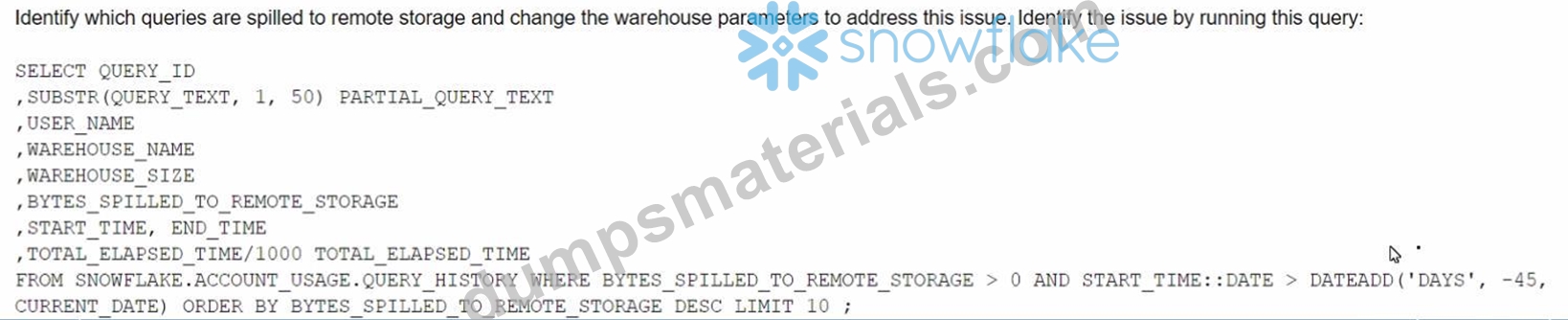
Answer: A
Explanation:
The image shows a SQL query that can be used to identify which queries are spilled to remote storage and suggests changing the warehouse parameters to address this issue. Spilling to remote storage occurs when the memory allocated to a warehouse is insufficient to process a query, and Snowflake uses disk or cloud storage as a temporary cache. This can significantly slow down the query performance and increase the cost. To troubleshoot this issue, a Snowflake Architect can run the query shown in the image to find out which queries are spilling, how much data they are spilling, and which warehouses they are using. Then, the architect can adjust the warehouse size, type, or scaling policy to provide enough memory for the queries and avoid spilling12. References:
* Recognizing Disk Spilling
* Managing the Kafka Connector
NEW QUESTION # 70
A new user user_01 is created within Snowflake. The following two commands are executed:
Command 1-> show grants to user user_01;
Command 2 ~> show grants on user user 01;
What inferences can be made about these commands?
- A. Command 1 defines all the grants which are given to user_01
Command 2 defines which role owns user 01 - B. Command 1 defines all the grants which are given to user_01 Command 2 defines which user owns user_01
- C. Command 1 defines which role owns user_01
Command 2 defines all the grants which have been given to user_01 - D. Command 1 defines which user owns user_01
Command 2 defines all the grants which have been given to user_01
Answer: A
Explanation:
The SHOW GRANTS command in Snowflake can be used to list all the access control privileges that have been explicitly granted to roles, users, and shares. The syntax and the output of the command vary depending on the object type and the grantee type specified in the command1. In this question, the two commands have the following meanings:
Command 1: show grants to user user_01; This command lists all the roles granted to the user user_01. The output includes the role name, the grantee name, and the granted by role name for each grant. This command is equivalent to show grants to user current_user if user_01 is the current user1.
Command 2: show grants on user user_01; This command lists all the privileges that have been granted on the user object user_01. The output includes the privilege name, the grantee name, and the granted by role name for each grant. This command shows which role owns the user object user_01, as the owner role has the privilege to modify or drop the user object2.
Therefore, the correct inference is that command 1 defines all the grants which are given to user_01, and command 2 defines which role owns user_01.
Reference:
SHOW GRANTS
Understanding Access Control in Snowflake
NEW QUESTION # 71
An Architect has been asked to clone schema STAGING as it looked one week ago, Tuesday June 1st at 8:00 AM, to recover some objects.
The STAGING schema has 50 days of retention.
The Architect runs the following statement:
CREATE SCHEMA STAGING_CLONE CLONE STAGING at (timestamp => '2021-06-01 08:00:00'); The Architect receives the following error: Time travel data is not available for schema STAGING. The requested time is either beyond the allowed time travel period or before the object creation time.
The Architect then checks the schema history and sees the following:
CREATED_ON|NAME|DROPPED_ON
2021-06-02 23:00:00 | STAGING | NULL
2021-05-01 10:00:00 | STAGING | 2021-06-02 23:00:00
How can cloning the STAGING schema be achieved?
- A. Undrop the STAGING schema and then rerun the CLONE statement.
- B. Rename the STAGING schema and perform an UNDROP to retrieve the previous STAGING schema version, then run the CLONE statement.
- C. Cloning cannot be accomplished because the STAGING schema version was not active during the proposed Time Travel time period.
- D. Modify the statement: CREATE SCHEMA STAGING_CLONE CLONE STAGING at (timestamp =>
'2021-05-01 10:00:00');
Answer: B
Explanation:
* The error message indicates that the schema STAGING does not have time travel data available for the requested timestamp, because the current version of the schema was created on 2021-06-02 23:00:00, which is after the timestamp of 2021-06-01 08:00:00. Therefore, the CLONE statement cannot access
* the historical data of the schema at that point in time.
* Option A is incorrect, because undropping the STAGING schema will not restore the previous version of the schema that was active on 2021-06-01 08:00:00. Instead, it will create a new version of the schema with the same name and no data or objects.
* Option B is incorrect, because modifying the timestamp to 2021-05-01 10:00:00 will not clone the schema as it looked one week ago, but as it looked when it was first created. This may not reflect the desired state of the schema and its objects.
* Option C is correct, because renaming the STAGING schema and performing an UNDROP to retrieve the previous STAGING schema version will restore the schema that was dropped on 2021-06-02
23:00:00. This schema has time travel data available for the requested timestamp of 2021-06-01
08:00:00, and can be cloned using the CLONE statement.
* Option D is incorrect, because cloning can be accomplished by using the UNDROP command to access the previous version of the schema that was active during the proposed time travel period.
References: : Cloning Considerations : Understanding & Using Time Travel : CREATE <object> ... CLONE
NEW QUESTION # 72
What is a characteristic of loading data into Snowflake using the Snowflake Connector for Kafka?
- A. Loads using the Connector will have lower latency than Snowpipe and will ingest data in real time.
- B. The Connector creates and manages its own stage, file format, and pipe objects.
- C. The Connector works with all file formats, including text, JSON, Avro, Ore, Parquet, and XML.
- D. The Connector only works in Snowflake regions that use AWS infrastructure.
Answer: B
Explanation:
According to the SnowPro Advanced: Architect documents and learning resources, a characteristic of loading data into Snowflake using the Snowflake Connector for Kafka is that the Connector creates and manages its own stage, file format, and pipe objects. The stage is an internal stage that is used to store the data files from the Kafka topics. The file format is a JSON or Avro file format that is used to parse the data files. The pipe is a Snowpipe object that is used to load the data files into the Snowflake table. The Connector automatically creates and configures these objects based on the Kafka configuration properties, and handles the cleanup and maintenance of these objects1.
The other options are incorrect because they are not characteristics of loading data into Snowflake using the Snowflake Connector for Kafka. Option A is incorrect because the Connector works in Snowflake regions that use any cloud infrastructure, not just AWS. The Connector supports AWS, Azure, and Google Cloud platforms, and can load data across different regions and cloud platforms using data replication2. Option B is incorrect because the Connector does not work with all file formats, only JSON and Avro. The Connector expects the data in the Kafka topics to be in JSON or Avro format, and parses the data accordingly. Other file formats, such as text, ORC, Parquet, or XML, are not supported by the Connector3. Option D is incorrect because loads using the Connector do not have lower latency than Snowpipe, and do not ingest data in real time. The Connector uses Snowpipe to load data into Snowflake, and inherits the same latency and performance characteristics of Snowpipe. The Connector does not provide real-time ingestion, but near real-time ingestion, depending on the frequency and size of the data files4. References: Installing and Configuring the Kafka Connector | Snowflake Documentation, Sharing Data Across Regions and Cloud Platforms | Snowflake Documentation, Overview of the Kafka Connector | Snowflake Documentation, Using Snowflake Connector for Kafka With Snowpipe Streaming | Snowflake Documentation
NEW QUESTION # 73
There are two databases in an account, named fin_db and hr_db which contain payroll and employee data, respectively. Accountants and Analysts in the company require different permissions on the objects in these databases to perform their jobs. Accountants need read-write access to fin_db but only require read-only access to hr_db because the database is maintained by human resources personnel.
An Architect needs to create a read-only role for certain employees working in the human resources department.
Which permission sets must be granted to this role?
- A. MODIFY on database hr_db, USAGE on all schemas in database hr_db, USAGE on all tables in database hr_db
- B. USAGE on database hr_db, SELECT on all schemas in database hr_db, SELECT on all tables in database hr_db
- C. USAGE on database hr_db, USAGE on all schemas in database hr_db, SELECT on all tables in database hr_db
- D. USAGE on database hr_db, USAGE on all schemas in database hr_db, REFERENCES on all tables in database hr_db
Answer: C
Explanation:
To create a read-only role for certain employees working in the human resources department, the role needs to have the following permissions on the hr_db database:
USAGE on the database: This allows the role to access the database and see its schemas and objects.
USAGE on all schemas in the database: This allows the role to access the schemas and see their objects.
SELECT on all tables in the database: This allows the role to query the data in the tables.
Option A is the correct answer because it grants the minimum permissions required for a read-only role on the hr_db database.
Option B is incorrect because SELECT on schemas is not a valid permission. Schemas only support USAGE and CREATE permissions.
Option C is incorrect because MODIFY on the database is not a valid permission. Databases only support USAGE, CREATE, MONITOR, and OWNERSHIP permissions. Moreover, USAGE on tables is not sufficient for querying the data. Tables support SELECT, INSERT, UPDATE, DELETE, TRUNCATE, REFERENCES, and OWNERSHIP permissions.
Option D is incorrect because REFERENCES on tables is not relevant for querying the data. REFERENCES permission allows the role to create foreign key constraints on the tables.
Reference:
: https://docs.snowflake.com/en/user-guide/security-access-control-privileges.html#database-privileges
: https://docs.snowflake.com/en/user-guide/security-access-control-privileges.html#schema-privileges
: https://docs.snowflake.com/en/user-guide/security-access-control-privileges.html#table-privileges
NEW QUESTION # 74
Which data models can be used when modeling tables in a Snowflake environment? (Select THREE).
- A. lnmon/3NF
- B. Dimensional/Kimball
- C. Graph model
- D. Data vault
- E. Bayesian hierarchical model
- F. Data lake
Answer: A,B,D
Explanation:
Snowflake is a cloud data platform that supports various data models for modeling tables in a Snowflake environment. The data models can be classified into two categories: dimensional and normalized. Dimensional data models are designed to optimize query performance and ease of use for business intelligence and analytics. Normalized data models are designed to reduce data redundancy and ensure data integrity for transactional and operational systems. The following are some of the data models that can be used in Snowflake:
* Dimensional/Kimball: This is a popular dimensional data model that uses a star or snowflake schema to organize data into fact and dimension tables. Fact tables store quantitative measures and foreign keys to dimension tables. Dimension tables store descriptive attributes and hierarchies. A star schema has a single denormalized dimension table for each dimension, while a snowflake schema has multiple normalized dimension tables for each dimension. Snowflake supports both star and snowflake schemas, and allows users to create views and joins to simplify queries.
* Inmon/3NF: This is a common normalized data model that uses a third normal form (3NF) schema to organize data into entities and relationships. 3NF schema eliminates data duplication and ensures data consistency by applying three rules: 1) every column in a table must depend on the primary key, 2)
* every column in a table must depend on the whole primary key, not a part of it, and 3) every column in a table must depend only on the primary key, not on other columns. Snowflake supports 3NF schema and allows users to create referential integrity constraints and foreign key relationships to enforce data quality.
* Data vault: This is a hybrid data model that combines the best practices of dimensional and normalized data models to create a scalable, flexible, and resilient data warehouse. Data vault schema consists of three types of tables: hubs, links, and satellites. Hubs store business keys and metadata for each entity.
Links store associations and relationships between entities. Satellites store descriptive attributes and historical changes for each entity or relationship. Snowflake supports data vault schema and allows users to leverage its features such as time travel, zero-copy cloning, and secure data sharing to implement data vault methodology.
References: What is Data Modeling? | Snowflake, Snowflake Schema in Data Warehouse Model - GeeksforGeeks, [Data Vault 2.0 Modeling with Snowflake]
NEW QUESTION # 75
An Architect is using SnowCD to investigate a connectivity issue.
Which system function will provide a list of endpoints that the network must be able to access to use a specific Snowflake account, leveraging private connectivity?
- A. SYSTEMSALLOWLIST_PRIVATELINK ()
- B. SYSTEMSALLOWLIST ()
- C. SYSTEMSAUTHORIZE_PRIVATELINK
- D. SYSTEMSGET_PRIVATELINK
Answer: A
NEW QUESTION # 76
How do Snowflake databases that are created from shares differ from standard databases that are not created from shares? (Choose three.)
- A. Shared databases are not supported by Time Travel.
- B. Shared databases can also be created as transient databases.
- C. Shared databases must be refreshed in order for new data to be visible.
- D. Shared databases cannot be cloned.
- E. Shared databases are read-only.
- F. Shared databases will have the PUBLIC or INFORMATION_SCHEMA schemas without explicitly granting these schemas to the share.
Answer: A,D,E
Explanation:
According to the SnowPro Advanced: Architect documents and learning resources, the ways that Snowflake databases that are created from shares differ from standard databases that are not created from shares are:
Shared databases are read-only. This means that the data consumers who access the shared databases cannot modify or delete the data or the objects in the databases. The data providers who share the databases have full control over the data and the objects, and can grant or revoke privileges on them1.
Shared databases cannot be cloned. This means that the data consumers who access the shared databases cannot create a copy of the databases or the objects in the databases. The data providers who share the databases can clone the databases or the objects, but the clones are not automatically shared2.
Shared databases are not supported by Time Travel. This means that the data consumers who access the shared databases cannot use the AS OF clause to query historical data or restore deleted data. The data providers who share the databases can use Time Travel on the databases or the objects, but the historical data is not visible to the data consumers3.
The other options are incorrect because they are not ways that Snowflake databases that are created from shares differ from standard databases that are not created from shares. Option B is incorrect because shared databases do not need to be refreshed in order for new data to be visible. The data consumers who access the shared databases can see the latest data as soon as the data providers update the data1. Option E is incorrect because shared databases will not have the PUBLIC or INFORMATION_SCHEMA schemas without explicitly granting these schemas to the share. The data consumers who access the shared databases can only see the objects that the data providers grant to the share, and the PUBLIC and INFORMATION_SCHEMA schemas are not granted by default4. Option F is incorrect because shared databases cannot be created as transient databases. Transient databases are databases that do not support Time Travel or Fail-safe, and can be dropped without affecting the retention period of the data. Shared databases are always created as permanent databases, regardless of the type of the source database5. Reference: Introduction to Secure Data Sharing | Snowflake Documentation, Cloning Objects | Snowflake Documentation, Time Travel | Snowflake Documentation, Working with Shares | Snowflake Documentation, CREATE DATABASE | Snowflake Documentation
NEW QUESTION # 77
Company A would like to share data in Snowflake with Company B.
Company B is not on the same cloud platform as Company A.
What is required to allow data sharing between these two companies?
- A. Ensure that all views are persisted, as views cannot be shared across cloud platforms.
- B. Create a pipeline to write shared data to a cloud storage location in the target cloud provider.
- C. Company A and Company B must agree to use a single cloud platform: Data sharing is only possible if the companies share the same cloud provider.
- D. Setup data replication to the region and cloud platform where the consumer resides.
Answer: D
NEW QUESTION # 78
An Architect needs to allow a user to create a database from an inbound share.
To meet this requirement, the user's role must have which privileges? (Choose two.)
- A. IMPORT DATABASE;
- B. CREATE DATABASE;
- C. CREATE SHARE;
- D. IMPORT SHARE;
- E. IMPORT PRIVILEGES;
Answer: B,E
NEW QUESTION # 79
......
Snowflake ARA-C01 is an advanced certification exam designed for those who want to demonstrate their expertise in Snowflake architecture, design, and implementation. SnowPro Advanced Architect Certification certification is targeted at experienced architects, engineers, and consultants who have a deep understanding of Snowflake's technology and can provide solutions to complex business problems. Passing the ARA-C01 exam demonstrates that an individual has the necessary skills and knowledge to design and implement advanced Snowflake solutions.
Check the Free demo of our ARA-C01 Exam Dumps with 163 Questions: https://braindumps2go.dumpsmaterials.com/ARA-C01-real-torrent.html
