
Free AZ-500 Exam Files Downloaded Instantly 100% Dumps & Practice Exam
Free Exam Updates AZ-500 dumps with test Engine Practice
Microsoft AZ-500 Exam Syllabus Topics:
| Topic | Details |
|---|---|
Manage identity and access (30-35%) | |
| Manage Azure Active Directory identities | - configure security for service principals - manage Azure AD directory groups - manage Azure AD users - manage administrative units - configure password writeback - configure authentication methods including password hash and Pass Through Authentication (PTA), OAuth, and passwordless - transfer Azure subscriptions between Azure AD tenants |
| Configure secure access by using Azure AD | - monitor privileged access for Azure AD Privileged Identity Management (PIM) - configure Access Reviews - Configure PIM - implement Conditional Access policies including Multi-Factor Authentication (MFA) - configure Azure AD identity protection |
| Manage application access | - create App Registration - configure App Registration permission scopes - manage App Registration permission consent - manage API access to Azure subscriptions and resources |
| Manage access control | - configure subscription and resource permissions - configure resource group permissions - configure custom RBAC roles - identify the appropriate role
- interpret permissions
|
Implement platform protection (15-20%) | |
| Implement advanced network security | - secure the connectivity of virtual networks (VPN authentication, Express Route encryption) - configure Network Security Groups (NSGs) and Application Security Groups (ASGs) - create and configure Azure Firewall - implement Azure Firewall Manager - configure Azure Front Door service as an Application Gateway - configure a Web Application Firewall (WAF) on Azure Application Gateway - configure Azure Bastion - configure a firewall on a storage account, Azure SQL, KeyVault, or App Service - implement Service Endpoints - implement DDoS protection |
| Configure advanced security for compute | - configure endpoint protection - configure and monitor system updates for VMs - configure authentication for Azure Container Registry - configure security for different types of containers
- implement Azure Disk Encryption
|
Manage security operations (25-30%) | |
| Monitor security by using Azure Monitor | - create and customize alerts - monitor security logs by using Azure Monitor - configure diagnostic logging and log retention |
Microsoft Azure Security Technologies AZ-500 Exam
The Azure Security Technologies AZ-500 exam is a Microsoft certification exam that was first made available in 2010. This exam is designed to validate your expertise in cloud security. With this exam, you can demonstrate your skills as a Cloud Services Engineer and Cloud Services Architect. Journey men who are just starting out with the Microsoft cloud can take this exam to show their mastery of core security technologies. Guides for this exam are available online, so you can study on your own time. Learning how to take this exam can help you prepare for other Microsoft certification exams that require an Azure technical certification. Monitor your progress with these Azure Security Technologies AZ-500 exam dumps. Accounts that are associated with the Azure cloud are protected using Azure Active Directory. Microsoft AZ-500 exam dumps can help you validate your understanding of these security features. Feel free to send comments if you have any questions about Azure Security Technologies AZ-500 certification exam.
Paying attention to Azure security technologies AZ-500 exam is a must. Measure your security skills against the Azure Security Technologies AZ-500 requirements. Build your reputation for competence in the complex field of cloud security technologies. Learners who demonstrate their mastery at the AZ-500 exam gain a competitive advantage as IT professionals. Options for validating your understanding of cloud security technologies include taking an exam or solving a series of problems. Comment if you have any questions about Azure security technologies AZ-500 exam. Focus first on the AZ-500 objectives and then study for other Azure technical exams including AZ-200, AZ-200, and AZ-510. Existing Azure users can work toward certification on Azure technologies.
NEW QUESTION 40
You are troubleshooting a security issue for an Azure Storage account.
You enable the diagnostic logs for the storage account.
What should you use to retrieve the diagnostics logs?
- A. SQL query editor in Azure
- B. File Explorer in Windows
- C. Azure Storage Explorer
- D. Azure Security Center
Answer: C
Explanation:
If you want to download the metrics for long-term storage or to analyze them locally, you must use a tool or write some code to read the tables. You must download the minute metrics for analysis. The tables do not appear if you list all the tables in your storage account, but you can access them directly by name. Many storage-browsing tools are aware of these tables and enable you to view them directly (see Azure Storage Client Tools for a list of available tools).
Microsoft provides several graphical user interface (GUI) tools for working with the data in your Azure Storage account. All of the tools outlined in the following table are free.
Note:
There are several versions of this question in the exam. The questions in the exam have two different correct answers:
1. Azure Storage Explorer
2. AZCopy
Other incorrect answer options you may see on the exam include the following:
1. Azure Monitor
2. The Security & Compliance admin center
3. Azure Cosmos DB explorer
4. Azure Monitor
Reference:
https://docs.microsoft.com/en-us/azure/storage/common/storage-analytics-metrics?toc=%2fazure%2fstorage%
2fblobs%2ftoc.json
https://docs.microsoft.com/en-us/azure/storage/common/storage-explorers
NEW QUESTION 41
Use the following login credentials as needed:
To enter your username, place your cursor in the Sign in box and click on the username below.
To enter your password, place your cursor in the Enter password box and click on the password below.
Azure Username: [email protected]
Azure Password: Ag1Bh9!#Bd
The following information is for technical support purposes only:
Lab Instance: 10598168


You need to ensure that the rg1lod10598168n1 Azure Storage account is encrypted by using a key stored in the KeyVault10598168 Azure key vault.
To complete this task, sign in to the Azure portal.
Answer:
Explanation:
Step 1: To enable customer-managed keys in the Azure portal, follow these steps:
1. Navigate to your storage account rg1lod10598168n1
2. On the Settings blade for the storage account, click Encryption. Select the Use your own key option, as shown in the following figure.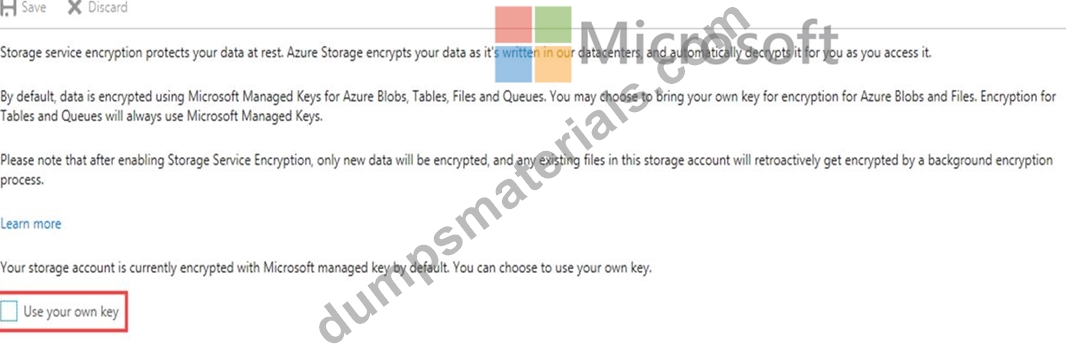
Step 2: Specify a key from a key vault
To specify a key from a key vault, first make sure that you have a key vault that contains a key. To specify a key from a key vault, follow these steps:
4. Choose the Select from Key Vault option.
5. Choose the key vault KeyVault10598168 containing the key you want to use.
6. Choose the key from the key vault.
Reference:
https://docs.microsoft.com/en-us/azure/storage/common/storage-encryption-keys-portal
NEW QUESTION 42
You have an Azure subscription that contains an Azure Active Directory (Azure AD) tenant named contoso.com. The tenant contains the users shown in the following table.
You create a resource group named RG1.
Which users can modify the permissions for RG1 and which users can create virtual networks in RG1? To answer, select the appropriate options in the answer area.
NOTE: Each correct selection is worth one point.
Answer:
Explanation:
Explanation:
Box 1: Only an owner can change permissions on resources.
Box 2: A Contributor can create/modify/delete anything in the subscription but cannot change permissions.
NEW QUESTION 43
You create a new Azure subscription that is associated to a new Azure Active Directory (Azure AD) tenant.
You create one active conditional access policy named Portal Policy. Portal Policy is used to provide access to the Microsoft Azure Management cloud app.
The Conditions settings for Portal Policy are configured as shown in the Conditions exhibit. (Click the Conditions tab.)
The Grant settings for Portal Policy are configured as shown in the Grant exhibit. (Click the Grant tab.)
For each of the following statements, select Yes if the statement is true. Otherwise, select No.
NOTE: Each correct selection is worth one point.
Answer:
Explanation:
Explanation
Box 1: No
The Contoso location is excluded
Box 2: NO
Box 3: NO
Reference:
https://docs.microsoft.com/en-us/azure/active-directory/conditional-access/location-condition
NEW QUESTION 44
You have an Azure Sentinel workspace that contains an Azure Active Directory (Azure AD) connector, an Azure Log Analytics query named Query1 and a playbook named Playbook1.
Query1 returns a subset of security events generated by Azure AD.
You plan to create an Azure Sentinel analytic rule based on Query1 that will trigger Playbook1.
You need to ensure that you can add Playbook1 to the new rule.
What should you do? To answer, select the appropriate options in the answer area.
NOTE: Each correct selection is worth one point.
Answer:
Explanation:
Reference:
https://docs.microsoft.com/en-us/azure/sentinel/tutorial-detect-threats-custom
https://docs.microsoft.com/en-us/azure/sentinel/tutorial-respond-threats-playbook
NEW QUESTION 45
You are configuring just in time (JIT) VM access to a set of Azure virtual machines.
You need to grant users PowerShell access to the virtual machine by using JIT VM access.
What should you configure? To answer, select the appropriate options in the answer area.
NOTE: Each correct selection is worth one point.
Answer:
Explanation:
NEW QUESTION 46
You plan to use Azure Disk Encryption for several virtual machine disks.
You need to ensure that Azure Disk Encryption can retrieve secrets from the KeyVault11641655 Azure key vault.
To complete this task, sign in to the Azure portal and modify the Azure resources.
See the explanation below.
Answer:
Explanation:
Explanation
1. In the Azure portal, type Key Vaults from the search results then select KeyVault11641655. Alternatively, browse to in the left navigation pane.
2. In the Key Vault properties, scroll down to the Access Policies.
3. Select the Azure Disk Encryption for volume encryption
4. Click Save to save the changes.
NEW QUESTION 47
You have an Azure subscription.
You create an Azure web app named Contoso1812 that uses an S1 App service plan.
You create a DNS record for www.contoso.com that points to the IP address of Contoso1812.
You need to ensure that users can access Contoso1812 by using the https://www.contoso.com URL.
Which two actions should you perform? Each correct answer presents part of the solution.
NOTE: Each correct selection is worth one point.
- A. Add a hostname to Contoso1812.
- B. Upload a PFX file to Contoso1812
- C. Scale up the App Service plan of Contoso1812.
- D. Add a deployment slot to Contoso1812.
- E. Turn on the system-assigned managed identity for Contoso1812.
- F. Scale out the App Service plan of Contoso1812.
Answer: A,B
Explanation:
B: You can configure Azure DNS to host a custom domain for your web apps. For example, you can create an Azure web app and have your users access it using either www.contoso.com or contoso.com as a fully qualified domain name (FQDN). To do this, you have to create three records:
A root "A" record pointing to contoso.com
A root "TXT" record for verification
A "CNAME" record for the www name that points to the A record
F: To use HTTPS, you need to upload a PFX file to the Azure Web App. The PFX file will contain the SSL certificate required for HTTPS.
References: https://docs.microsoft.com/en-us/azure/dns/dns-web-sites-custom- Domain
NEW QUESTION 48
Note: This question is part of a series of questions that present the same scenario. Each question in the series contains a unique solution that might meet the stated goals. Some question sets might have more than one correct solution, while others might not have a correct solution.
After you answer a question in this section, you will NOT be able to return to it. As a result, these questions will not appear in the review screen.
You have an Azure Subscription named Sub1. Sub1 contains an Azure virtual machine named VM1 that runs Windows Server 2016.
You need to encrypt VM1 disks by using Azure Disk Encryption.
Which three actions should you perform in sequence? To answer, move the appropriate actions from the list of actions to the answer area and arrange them in the correct order.
Answer:
Explanation:
Explanation
References:
https://docs.microsoft.com/en-us/azure/virtual-machines/windows/encrypt-disks
NEW QUESTION 49
You are evaluating the security of the network communication between the virtual machines in Sub2.
For each of the following statements, select Yes if the statement is true. Otherwise, select No.
NOTE: Each correct selection is worth one point.
Answer:
Explanation:
Explanation
No,
Yes,
Yes
NEW QUESTION 50
You have an Azure subscription. The subscription contains Azure virtual machines that run Windows Server
2016.
You need to implement a policy to ensure that each virtual machine has a custom antimalware virtual machine extension installed.
How should you complete the policy? To answer, select the appropriate options in the answer area.
NOTE: Each correct selection is worth one point.
Answer:
Explanation:
Explanation
Box 1: DeployIfNotExists
DeployIfNotExists executes a template deployment when the condition is met.
Box 2: Template
The details property of the DeployIfNotExists effects has all the subproperties that define the related resources to match and the template deployment to execute.
Deployment [required]
This property should include the full template deployment as it would be passed to the Microsoft.Resources/deployment References:
https://docs.microsoft.com/en-us/azure/governance/policy/concepts/effects
NEW QUESTION 51
You have an Azure subscription named Subcription1 that contains the resources shown in the following table.
You have an Azure subscription named Subcription2 that contains the following resources:
An Azure Sentinel workspace
An Azure Event Grid instance
You need to ingest the CEF messages from the NVAs to Azure Sentinel.
NOTE: Each correct selection is worth one point.
Answer:
Explanation:
NEW QUESTION 52
You have an Azure Active Directory (Azure AD) tenant named contoso.com that contains the users shown in the following table.
You create and enforce an Azure AD Identity Protection user risk policy that has the following settings:
* Assignment: Include Group1, Exclude Group2
* Conditions: Sign-in risk of Medium and above
* Access: Allow access, Require password change
For each of the following statements, select Yes if the statement is true. Otherwise, select No.
NOTE: Each correct selection is worth one point.
Answer:
Explanation:
Explanation
Box 1: Yes
User1 is member of Group1. Sign in from unfamiliar location is risk level Medium.
Box 2: Yes
User2 is member of Group1. Sign in from anonymous IP address is risk level Medium.
Box 3: No
Sign-ins from IP addresses with suspicious activity is low.
Note:
Azure AD Identity protection can detect six types of suspicious sign-in activities:
* Users with leaked credentials
* Sign-ins from anonymous IP addresses
* Impossible travel to atypical locations
* Sign-ins from infected devices
* Sign-ins from IP addresses with suspicious activity
* Sign-ins from unfamiliar locations
These six types of events are categorized in to 3 levels of risks - High, Medium & Low:
References:
http://www.rebeladmin.com/2018/09/step-step-guide-configure-risk-based-azure-conditional-access-policies/
NEW QUESTION 53
You have an Azure subscription named Sub1. Sub1 contains a virtual network named VNet1 that contains one
subnet named Subnet1.
You create a service endpoint for Subnet1.
Subnet1 contains an Azure virtual machine named VM1 that runs Ubuntu Server 18.04.
You need to deploy Docker containers to VM1. The containers must be able to access Azure Storage
resources and Azure SQL databases by using the service endpoint.
What should you do on VM1 before you deploy the container?
- A. Create an application security group and a network security group (NSG).
- B. Edit the docker-compose.yml file.
- C. Install the container network interface (CNI) plug-in.
Answer: C
Explanation:
The Azure Virtual Network container network interface (CNI) plug-in installs in an Azure Virtual Machine. The
plug-in supports both Linux and Windows platform.
The plug-in assigns IP addresses from a virtual network to containers brought up in the virtual machine,
attaching them to the virtual network, and connecting them directly to other containers and virtual network
resources. The plug-in doesn't rely on overlay networks, or routes, for connectivity, and provides the same
performance as virtual machines.
The following picture shows how the plug-in provides Azure Virtual Network capabilities to Pods:
References:
https://docs.microsoft.com/en-us/azure/virtual-network/container-networking-overview
NEW QUESTION 54
Use the following login credentials as needed:
To enter your username, place your cursor in the Sign in box and click on the username below.
To enter your password, place your cursor in the Enter password box and click on the password below.
Azure Username: [email protected]
Azure Password: Ag1Bh9!#Bd
The following information is for technical support purposes only:
Lab Instance: 10598168


You need to ensure that the rg1lod10598168n1 Azure Storage account is encrypted by using a key stored in the KeyVault10598168 Azure key vault.
To complete this task, sign in to the Azure portal.
Answer:
Explanation:
See the explanation below.
Explanation
Step 1: To enable customer-managed keys in the Azure portal, follow these steps:
1. Navigate to your storage account rg1lod10598168n1
2. On the Settings blade for the storage account, click Encryption. Select the Use your own key option, as shown in the following figure.
Step 2: Specify a key from a key vault
To specify a key from a key vault, first make sure that you have a key vault that contains a key. To specify a key from a key vault, follow these steps:
4. Choose the Select from Key Vault option.
5. Choose the key vault KeyVault10598168 containing the key you want to use.
6. Choose the key from the key vault.
Reference:
https://docs.microsoft.com/en-us/azure/storage/common/storage-encryption-keys-portal
NEW QUESTION 55
You have an Azure subscription that contains a web app named App1 and an Azure key vault named Vault1.
You need to configure App1 to store and access the secrets in Vault1.
How should you configure App1? To answer, select the appropriate options in the answer area.
NOTE: Each correct selection is worth one point.
Answer:
Explanation:
Reference:
https://docs.microsoft.com/en-us/azure/app-service/overview-managed-identity?tabs=dotnet
NEW QUESTION 56
You have an Azure subscription that contains an Azure key vault named ContosoKey1.
You create users and assign them roles as shown in the following table.
You need to identify which users can perform the following actions:
Delegate permissions for ContsosKey1.
Configure network access to ContosoKey1.
Which users should you identify? To answer, select the appropriate options in the answer area.
NOTE: Each correct selection is worth one point.
Answer:
Explanation: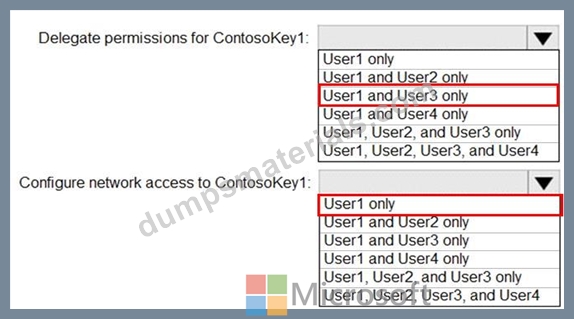
Reference:
https://docs.microsoft.com/en-gb/azure/key-vault/general/rbac-guide
NEW QUESTION 57
You need to configure SQLDB1 to meet the data and application requirements.
Which three actions should you recommend be performed in sequence? To answer, move the appropriate actions from the list of actions to the answer area and arrange them in the correct order.
Answer:
Explanation:
Explanation
Step 1: Connect to SQLDB1 by using Microsoft SQL Server Management Studio (SSMS) Step 2: In SQLDB1, create contained database users.
Create a contained user in the database that represents the VM's system-assigned identity.
Step 3: In Azure AD,create a system-assigned managed identity.
A system-assigned identity for a Windows virtual machine (VM) can be used to access an Azure SQL server.
Managed Service Identities are automatically managed by Azure and enable you to authenticate to services that support Azure AD authentication, without needing to insert credentials into your code.
References:
https://docs.microsoft.com/en-us/azure/active-directory/managed-identities-azure-resources/tutorial-windows-vm
NEW QUESTION 58
You have three on-premises servers named Server1, Server2, and Server3 that run Windows. Server1 and Server2 and located on the Internal network. Server3 is located on the premises network. All servers have access to Azure.
https://www.fast2test.com/AZ-500-practice-test.html 67
Valid Fast2test AZ-500 Exam PDF Dumps - New AZ-500 Real Exam Questions
From Azure Sentinel, you install a Windows firewall data connector.
You need to collect Microsoft Defender Firewall data from the servers for Azure Sentinel.
What should you do?
- A. Create an event subscription from Server1, Server2 and Server3
- B. Install the Microsoft Agent on Server1 and Server2 install the on-premises data gateway on Server3.
- C. Install the On-premises data gateway on each server.
- D. Install the Microsoft Agent on each server.
Answer: D
Explanation:
Explanation/Reference:
https://docs.microsoft.com/en-us/azure/sentinel/connect-windows-firewall
NEW QUESTION 59
......
Demonstrate the knowledge of Microsoft AZ-500 Exam
Workers who specialize in Azure security technologies can land highly paid jobs. Confidently take the AZ-500 exam and find your right career path. Hybrid cloud environments are an important part of the Microsoft cloud. Huge growth in the popularity of Azure is providing workers with great opportunities for career advancement. Incredible opportunities for workers and companies alike will exist in the coming years with cloud computing. Failure to keep up with your studies can put your career at risk. Safety of data is highly important in hybrid cloud environments. Ease of managing security is critical in cloud environments. Mind your own career and study for AZ-500 objectives to validate your understanding of cloud security. Knowing how to take the AZ-500 exam will make you a valuable contributor in any organization.
Provide Valid Dumps To Help You Prepare For Microsoft Azure Security Technologies Exam: https://braindumps2go.dumpsmaterials.com/AZ-500-real-torrent.html
