
Get Ready to Pass the MCPA-Level-1 exam Right Now Using Our MuleSoft Certified Platform Architect Exam Package
Enhance Your Career With Available Preparation Guide for MCPA-Level-1 Exam
How to Prepare for MuleSoft MCPA - Level 1: MuleSoft Certified Platform Architect - Level 1 Exam
Preparation Guide for MuleSoft MCPA - Level 1: MuleSoft Certified Platform Architect - Level 1 Exam
Introduction
MuleSoft has a unique community and they have multiple certifications to choose from. Individuals can go ahead and appear for certification which they find suitable as per their expertise and skillset. MuleSoft also recognizes that the community is an important way to engage with its customer base.
Certification is evidence of your skills, expertise in those areas in which you like to work. If a candidate wants to work on MuleSoft MCPA - Level 1: MuleSoft Certified Platform Architect - Level 1 and prove his knowledge, Certification is offered by MuleSoft. This MuleSoft MCPA - Level 1: MuleSoft Certified Platform Architect - Level 1 Individuals Qualification Certification helps a candidate to validates his skills in MuleSoft MCPA - Level 1: MuleSoft Certified Platform Architect - Level 1. In this guide we will cover mcpa-level-1 practice exams and all the aspects of mcpa-level-1 exam dumps.
NEW QUESTION 45
An API implementation is deployed on a single worker on CloudHub and invoked by external API clients (outside of CloudHub). How can an alert be set up that is guaranteed to trigger AS SOON AS that API implementation stops responding to API invocations?
- A. Configure a "worker not responding" alert in Anypoint Runtime Manager
- B. Handle API invocation exceptions within the calling API client and raise an alert from that API client when the API Is unavailable
- C. Create an alert for when the API receives no requests within a specified time period
- D. Implement a heartbeat/health check within the API and invoke it from outside the Anypoint Platform and alert when the heartbeat does not respond
Answer: A
Explanation:
Correct answer: Configure a "Worker not responding" alert in Anypoint Runtime Manager.
*****************************************
>> All the options eventually helps to generate the alert required when the application stops responding.
>> However, handling exceptions within calling API and then raising alert from API client is inappropriate and silly. There could be many API clients invoking the API implementation and it is not ideal to have this setup consistently in all of them. Not a realistic way to do.
>> Implementing a health check/ heartbeat with in the API and calling from outside to detmine the health sounds OK but needs extra setup for it and same time there are very good chances of generating false alarms when there are any intermittent network issues between external tool calling the health check API on API implementation. The API implementation itself may not have any issues but due to some other factors some false alarms may go out.
>> Creating an alert in API Manager when the API receives no requests within a specified time period would actually generate realistic alerts but even here some false alarms may go out when there are genuinely no requests from API clients.
The best and right way to achieve this requirement is to setup an alert on Runtime Manager with a condition "Worker not responding". This would generate an alert AS SOON AS the workers become unresponsive.
NEW QUESTION 46
What is true about where an API policy is defined in Anypoint Platform and how it is then applied to API instances?
- A. The API policy Is defined in API Manager and then automatically applied to ALL API instances
- B. The API policy Is defined In API Manager for a specific API Instance, and then ONLY applied to the specific API instance
- C. The API policy Is defined In Runtime Manager as part of the API deployment to a Mule runtime, and then ONLY applied to the specific API Instance
- D. The API policy is defined in API Manager, and then applied to ALL API instances in the specified environment
Answer: C
NEW QUESTION 47
An organization has several APIs that accept JSON data over HTTP POST. The APIs are all publicly available and are associated with several mobile applications and web applications.
The organization does NOT want to use any authentication or compliance policies for these APIs, but at the same time, is worried that some bad actor could send payloads that could somehow compromise the applications or servers running the API implementations.
What out-of-the-box Anypoint Platform policy can address exposure to this threat?
- A. Apply an IP blacklist policy to all APIs; the blacklist will Include all bad actors
- B. Apply a Header injection and removal policy that detects the malicious data before it is used
- C. Shut out bad actors by using HTTPS mutual authentication for all API invocations
- D. Apply a JSON threat protection policy to all APIs to detect potential threat vectors
Answer: D
Explanation:
Correct answer: Apply a JSON threat protection policy to all APIs to detect potential threat vectors
*****************************************
>> Usually, if the APIs are designed and developed for specific consumers (known consumers/customers) then we would IP Whitelist the same to ensure that traffic only comes from them.
>> However, as this scenario states that the APIs are publicly available and being used by so many mobile and web applications, it is NOT possible to identify and blacklist all possible bad actors.
>> So, JSON threat protection policy is the best chance to prevent any bad JSON payloads from such bad actors.
NEW QUESTION 48
A REST API is being designed to implement a Mule application.
What standard interface definition language can be used to define REST APIs?
- A. YAML
- B. OpenAPI Specification (OAS)
- C. AsyncAPI Specification
- D. Web Service Definition Language(WSDL)
Answer: B
NEW QUESTION 49
What is true about automating interactions with Anypoint Platform using tools such as Anypoint Platform REST APIs, Anypoint CLI, or the Mule Maven plugin?
- A. By default, the Anypoint CLI and Mule Maven plugin are NOT included in the Mule runtime, so are NOT available to be used by deployed Mule applications.
- B. API policies can be applied to the Anypoint Platform APIs so that ONLY certain LOBs have access to specific functions.
- C. Anypoint Platform APIs can ONLY automate interactions with CloudHub, while the Mule Maven plugin is required for deployment to customer-hosted Mule runtimes
- D. Access to Anypoint Platform APIs and Anypoint CLI can be controlled separately through the roles and permissions in Anypoint Platform, so that specific users can get access to Anypoint CLI while others get access to the platform APIs.
Answer: A
NEW QUESTION 50
Refer to the exhibit.
what is true when using customer-hosted Mule runtimes with the MuleSoft-hosted Anypoint Platform control plane (hybrid deployment)?
- A. API implementations can run successfully in customer-hosted Mule runtimes, even when they are unable to communicate with the control plane
- B. The MuleSoft-hosted Shared Load Balancer can be used to load balance API invocations to the Mule runtimes
- C. Anypoint Runtime Manager initiates a network connection to a Mule runtime in order to deploy Mule applications
- D. Anypoint Runtime Manager automatically ensures HA in the control plane by creating a new Mule runtime instance in case of a node failure
Answer: D
NEW QUESTION 51
What are the major benefits of MuleSoft proposed IT Operating Model?
- A. 1. Decrease the IT delivery gap
2. Meet various business demands by increasing the IT capacity and forming various IT departments
3. Make consumption of assets at the rate of production - B. 1. Decrease the IT delivery gap
2. Meet various business demands without increasing the IT capacity
3. Make consumption of assets at the rate of production - C. 1. Decrease the IT delivery gap
2. Meet various business demands without increasing the IT capacity
3. Focus on creation of reusable assets first. Upon finishing creation of all the possible assets then inform the LOBs in the organization to start using them
Answer: B
Explanation:
Correct answer:
1. Decrease the IT delivery gap
2. Meet various business demands without increasing the IT capacity
3. Make consumption of assets at the rate of production.
*****************************************
Reference:

NEW QUESTION 52
How are an API implementation, API client, and API consumer combined to invoke and process an API?
- A. The ApI client creates an API consumer, which sends API invocations to an API such that they are processed by an API implementation
- B. The API client creates an API consumer, which receives API invocations from an API such that they are processed for an API implementation
- C. The API consumer creates an API implementation, which receives API invocations from an API such that they are processed for an API client
- D. The ApI consumer creates an API client, which sends API invocations to an API such that they are processed by an API implementation
Answer: D
Explanation:
Correct answer: The API consumer creates an API client, which sends API invocations to an API such that they are processed by an API implementation
*****************************************
Terminology:
>> API Client - It is a piece of code or program the is written to invoke an API
>> API Consumer - An owner/entity who owns the API Client. API Consumers write API clients.
>> API - The provider of the API functionality. Typically an API Instance on API Manager where they are managed and operated.
>> API Implementation - The actual piece of code written by API provider where the functionality of the API is implemented. Typically, these are Mule Applications running on Runtime Manager.
NEW QUESTION 53
Refer to the exhibit.
A developer is building a client application to invoke an API deployed to the STAGING environment that is governed by a client ID enforcement policy.
What is required to successfully invoke the API?
- A. The client ID and secret for the Anypoint Platform account owning the API in the STAGING environment
- B. The client ID and secret obtained from Anypoint Exchange for the API instance in the STAGING environment
- C. A valid OAuth token obtained from Anypoint Platform and its associated client ID and secret
- D. The client ID and secret for the Anypoint Platform account's STAGING environment
Answer: C
Explanation:
Explanation
https://docs.mulesoft.com/api-manager/2.x/policy-mule3-client-id-based-policies
NEW QUESTION 54
What API policy would LEAST likely be applied to a Process API?
- A. Rate limiting
- B. Client ID enforcement
- C. Custom circuit breaker
- D. JSON threat protection
Answer: C
NEW QUESTION 55
Due to a limitation in the backend system, a system API can only handle up to 500 requests per second. What is the best type of API policy to apply to the system API to avoid overloading the backend system?
- A. Rate limiting
- B. Spike control
- C. HTTP caching
- D. Rate limiting - SLA based
Answer: B
Explanation:
Correct answer: Spike control
*****************************************
>> First things first, HTTP Caching policy is for purposes different than avoiding the backend system from overloading. So this is OUT.
>> Rate Limiting and Throttling/ Spike Control policies are designed to limit API access, but have different intentions.
>> Rate limiting protects an API by applying a hard limit on its access.
>> Throttling/ Spike Control shapes API access by smoothing spikes in traffic.
That is why, Spike Control is the right option.
NEW QUESTION 56
What best describes the Fully Qualified Domain Names (FQDNs), also known as DNS entries, created when a Mule application is deployed to the CloudHub Shared Worker Cloud?
- A. The FQDNs are determined by the application name chosen, IRRESPECTIVE of the region
- B. A fixed number of FQDNs are created, IRRESPECTIVE of the environment and VPC design
- C. The FQDNs are determined by the application name, but can be modified by an administrator after deployment
- D. The FQDNs are determined by both the application name and the Anypoint Platform organization
Answer: B
NEW QUESTION 57
An organization has created an API-led architecture that uses various API layers to integrate mobile clients with a backend system. The backend system consists of a number of specialized components and can be accessed via a REST API. The process and experience APIs share the same bounded-context model that is different from the backend data model. What additional canonical models, bounded-context models, or anti-corruption layers are best added to this architecture to help process data consumed from the backend system?
- A. Create a canonical model that combines the backend and API-led models to simplify and unify data models, and minimize data transformations.
- B. Create a bounded-context model for every layer and overlap them when the boundary contexts overlap, letting API developers know about the differences between upstream and downstream data models
- C. Create a bounded-context model for the system layer to closely match the backend data model, and add an anti-corruption layer to let the different bounded contexts cooperate across the system and process layers
- D. Create an anti-corruption layer for every API to perform transformation for every data model to match each other, and let data simply travel between APIs to avoid the complexity and overhead of building canonical models
Answer: C
Explanation:
Correct answer: Create a bounded-context model for the system layer to closely match the backend data model, and add an anti-corruption layer to let the different bounded contexts cooperate across the system and process layers
*****************************************
>> Canonical models are not an option here as the organization has already put in efforts and created bounded-context models for Experience and Process APIs.
>> Anti-corruption layers for ALL APIs is unnecessary and invalid because it is mentioned that experience and process APIs share same bounded-context model. It is just the System layer APIs that need to choose their approach now.
>> So, having an anti-corruption layer just between the process and system layers will work well. Also to speed up the approach, system APIs can mimic the backend system data model.
NEW QUESTION 58
What do the API invocation metrics provided by Anypoint Platform provide?
- A. Measurements of the effectiveness of the application network based on the level of reuse
- B. ROI metrics from APIs that can be directly shared with business users
- C. Data on past API invocations to help identify anomalies and usage patterns across various APIs
- D. Proactive identification of likely future policy violations that exceed a given threat threshold
Answer: C
Explanation:
Correct answer: Data on past API invocations to help identify anomalies and usage patterns across various APIs
*****************************************
API Invocation metrics provided by Anypoint Platform:
>> Does NOT provide any Return Of Investment (ROI) related information. So the option suggesting it is OUT.
>> Does NOT provide any information w.r.t how APIs are reused, whether there is effective usage of APIs or not etc...
>> Does NOT prodive any prediction information as such to help us proactively identify any future policy violations.
So, the kind of data/information we can get from such metrics is on past API invocations to help identify anomalies and usage patterns across various APIs.
NEW QUESTION 59
What is a key requirement when using an external Identity Provider for Client Management in Anypoint Platform?
- A. Single sign-on is required to sign in to Anypoint Platform
- B. To invoke OAuth 2.0-protected APIs managed by Anypoint Platform, API clients must submit access tokens issued by that same Identity Provider
- C. APIs managed by Anypoint Platform must be protected by SAML 2.0 policies
- D. The application network must include System APIs that interact with the Identity Provider
Answer: C
NEW QUESTION 60
An organization wants MuleSoft-hosted runtime plane features (such as HTTP load balancing, zero downtime, and horizontal and vertical scaling) in its Azure environment. What runtime plane minimizes the organization's effort to achieve these features?
- A. Anypoint Runtime Fabric
- B. CloudHub
- C. Anypoint Platform for Pivotal Cloud Foundry
- D. A hybrid combination of customer-hosted and MuleSoft-hosted Mule runtimes
Answer: A
Explanation:
Correct answer: Anypoint Runtime Fabric
*****************************************
>> When a customer is already having an Azure environment, It is not at all an ideal approach to go with hybrid model having some Mule Runtimes hosted on Azure and some on MuleSoft. This is unnecessary and useless.
>> CloudHub is a Mulesoft-hosted Runtime plane and is on AWS. We cannot customize to point CloudHub to customer's Azure environment.
>> Anypoint Platform for Pivotal Cloud Foundry is specifically for infrastructure provided by Pivotal Cloud Foundry
>> Anypoint Runtime Fabric is right answer as it is a container service that automates the deployment and orchestration of Mule applications and API gateways. Runtime Fabric runs within a customer-managed infrastructure on AWS, Azure, virtual machines (VMs), and bare-metal servers.
-Some of the capabilities of Anypoint Runtime Fabric include:
-Isolation between applications by running a separate Mule runtime per application.
-Ability to run multiple versions of Mule runtime on the same set of resources.
-Scaling applications across multiple replicas.
-Automated application fail-over.
-Application management with Anypoint Runtime Manager.
NEW QUESTION 61
A company wants to move its Mule API implementations into production as quickly as possible. To protect access to all Mule application data and metadata, the company requires that all Mule applications be deployed to the company's customer-hosted infrastructure within the corporate firewall. What combination of runtime plane and control plane options meets these project lifecycle goals?
- A. Manually provisioned customer-hosted runtime plane and customer-hosted control plane
- B. MuleSoft-hosted runtime plane and customer-hosted control plane
- C. Manually provisioned customer-hosted runtime plane and MuleSoft-hosted control plane
- D. iPaaS provisioned customer-hosted runtime plane and MuleSoft-hosted control plane
Answer: A
Explanation:
Correct answer: Manually provisioned customer-hosted runtime plane and customer-hosted control plane
*****************************************
There are two key factors that are to be taken into consideration from the scenario given in the question.
>> Company requires both data and metadata to be resided within the corporate firewall
>> Company would like to go with customer-hosted infrastructure.
Any deployment model that is to deal with the cloud directly or indirectly (Mulesoft-hosted or Customer's own cloud like Azure, AWS) will have to share atleast the metadata.
Application data can be controlled inside firewall by having Mule Runtimes on customer hosted runtime plane. But if we go with Mulsoft-hosted/ Cloud-based control plane, the control plane required atleast some minimum level of metadata to be sent outside the corporate firewall.
As the customer requirement is pretty clear about the data and metadata both to be within the corporate firewall, even though customer wants to move to production as quickly as possible, unfortunately due to the nature of their security requirements, they have no other option but to go with manually provisioned customer-hosted runtime plane and customer-hosted control plane.
NEW QUESTION 62
What is typically NOT a function of the APIs created within the framework called API-led connectivity?
- A. They reduce the dependency on the underlying backend systems by helping unlock data from backend systems In a reusable and consumable way.
- B. They allow for innovation at the user Interface level by consuming the underlying assets without being aware of how data Is being extracted from backend systems.
- C. They can compose data from various sources and combine them with orchestration logic to create higher level value.
- D. They provide an additional layer of resilience on top of the underlying backend system, thereby insulating clients from extended failure of these systems.
Answer: D
Explanation:
Correct answer: They provide an additional layer of resilience on top of the underlying backend system, thereby insulating clients from extended failure of these systems.
*****************************************
In API-led connectivity,
>> Experience APIs - allow for innovation at the user interface level by consuming the underlying assets without being aware of how data is being extracted from backend systems.
>> Process APIs - compose data from various sources and combine them with orchestration logic to create higher level value
>> System APIs - reduce the dependency on the underlying backend systems by helping unlock data from backend systems in a reusable and consumable way.
However, they NEVER promise that they provide an additional layer of resilience on top of the underlying backend system, thereby insulating clients from extended failure of these systems.
https://dzone.com/articles/api-led-connectivity-with-mule
NEW QUESTION 63
The responses to some HTTP requests can be cached depending on the HTTP verb used in the request. According to the HTTP specification, for what HTTP verbs is this safe to do?
- A. PUT, POST, DELETE
- B. GET, HEAD, POST
- C. GET, PUT, OPTIONS
- D. GET, OPTIONS, HEAD
Answer: D
Explanation:
Correct answer: GET, OPTIONS, HEAD
http://restcookbook.com/HTTP%20Methods/idempotency/
NEW QUESTION 64
What best describes the Fully Qualified Domain Names (FQDNs), also known as DNS entries, created when a Mule application is deployed to the CloudHub Shared Worker Cloud?
- A. A fixed number of FQDNs are created, IRRESPECTIVE of the environment and VPC design
- B. The FQDNs are determined by the application name, but can be modified by an administrator after deployment
- C. The FQDNs are determined by both the application name and the Anypoint Platform organization
- D. The FQDNs are determined by the application name chosen, IRRESPECTIVE of the region
Answer: D
Explanation:
Correct answer: The FQDNs are determined by the application name chosen, IRRESPECTIVE of the region
*****************************************
>> When deploying applications to Shared Worker Cloud, the FQDN are always determined by application name chosen.
>> It does NOT matter what region the app is being deployed to.
>> Although it is fact and true that the generated FQDN will have the region included in it (Ex: exp-salesorder-api.au-s1.cloudhub.io), it does NOT mean that the same name can be used when deploying to another CloudHub region.
>> Application name should be universally unique irrespective of Region and Organization and solely determines the FQDN for Shared Load Balancers.
NEW QUESTION 65
Refer to the exhibit.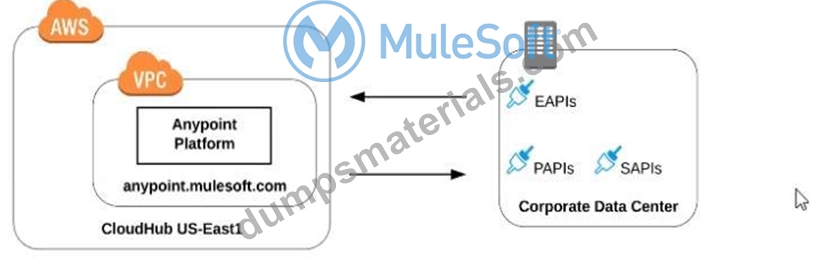
what is true when using customer-hosted Mule runtimes with the MuleSoft-hosted Anypoint Platform control plane (hybrid deployment)?
- A. API implementations can run successfully in customer-hosted Mule runtimes, even when they are unable to communicate with the control plane
- B. The MuleSoft-hosted Shared Load Balancer can be used to load balance API invocations to the Mule runtimes
- C. Anypoint Runtime Manager initiates a network connection to a Mule runtime in order to deploy Mule applications
- D. Anypoint Runtime Manager automatically ensures HA in the control plane by creating a new Mule runtime instance in case of a node failure
Answer: C
NEW QUESTION 66
......
MuleSoft MCPA - Level 1: MuleSoft Certified Platform Architect - Level 1 Exam Certified Professional salary
The average salary of a MuleSoft MCPA - Level 1: MuleSoft Certified Platform Architect - Level 1 Exam Certified Expert in:
- United State - 100,200 USD
- India. - 14,00,327 INR
- England - 75,000 POUND
- Europe - 70,500 EURO
MuleSoft MCPA-Level-1 Exam Syllabus Topics:
| Topic | Details |
|---|---|
| Topic 1 |
|
| Topic 2 |
|
| Topic 3 |
|
| Topic 4 |
|
| Topic 5 |
|
| Topic 6 |
|
| Topic 7 |
|
| Topic 8 |
|
Get Special Discount Offer of MCPA-Level-1 Certification Exam Sample Questions and Answers: https://braindumps2go.dumpsmaterials.com/MCPA-Level-1-real-torrent.html
