
Latest Adobe AD0-E556 Practice Test Questions, Adobe Marketo Engage Architect Exam Dumps
Oct-2023 Pass Adobe AD0-E556 Exam in First Attempt Easily
Adobe AD0-E556 Exam Syllabus Topics:
| Topic | Details |
|---|---|
| Topic 1 |
|
| Topic 2 |
|
| Topic 3 |
|
| Topic 4 |
|
| Topic 5 |
|
| Topic 6 |
|
NEW QUESTION # 19
The marketing team at a multinational company needs to better understand their marketing effectiveness. The team is planning for the next fiscal year and must decide how to allocate budget to the various marketing channels. Spending must be cut by $1,000,000. The team needs to decide what they are not going to do next year. By using program analyzer, extracting the information, and populating an Excel sheet, the team is able to analyze the following data.
Based on the data from this year's marketing metrics, which conclusion can be made to help make decisions for next year?
- A. Webinars provide the best ROI for acquiring new names because of the low cost. Tradeshows q provide the least ROI because of the high cost. To help the company save money without sacrificing returns, they need to cut Tradeshows by $1 million.
- B. Tradeshows returns the greatest ROI for acquiring new names, and webinars return the greatest q ROI for engaging people down the funnel. Due to paid social performance, the marketing team decides to cut back on spend by $1 million and opts not to do any paid social campaigns.
- C. Paid social is performing the best on average for both acquiring new names and engaging with q people down the funnel to generate pipeline. The team needs to cut $333,333 in each channel to spread out the cutbacks.
Answer: A
Explanation:
Explanation
The conclusion that can be made based on the data from this year's marketing metrics is that webinars provide the best ROI for acquiring new names because of the low cost, and tradeshows provide the least ROI because of the high cost. To help the company save money without sacrificing returns, they need to cut tradeshows by
$1 million. This conclusion can be derived from analyzing the data in terms of cost per acquisition (CPA), return on investment (ROI), and budget allocation. Webinars have the lowest CPA ($10) and the highest ROI (900%) among all channels, which means they are the most efficient and effective way to acquire new names.
Tradeshows have the highest CPA ($100) and the lowest ROI (100%) among all channels, which means they are the least efficient and effective way to acquire new names. Tradeshows also have the largest budget allocation ($1 million) among all channels, which means they are consuming a lot of resources without generating much value. Therefore, cutting tradeshows by $1 million will help the company reduce costs and increase returns.
References: https://docs.marketo.com/display/public/DOCS/Program+Analyzer
https://docs.marketo.com/display/public/DOCS/Program+ROI
NEW QUESTION # 20 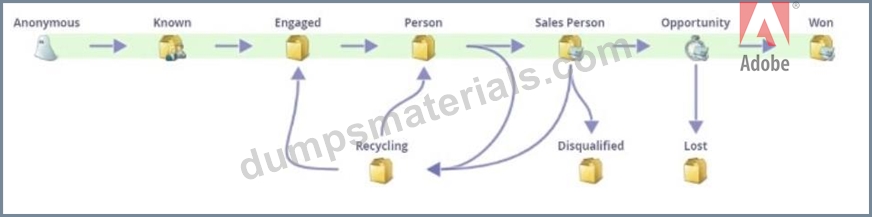
Refer to the lifecycle model above.
A company wants improve the efficiency of its sales follow-up and enhance its velocity reporting across the funnel. The company currently uses the out-of-box Adobe Marketo Engage success with detours modeler. The stages are defined as:
1. Anonymous: Leads whose web activity is tracked, but whose identity is not known yet
2. Known: Leads for whom we have an email address or other information that allows us to market to them
3. Engaged: Leads that have engaged us by filling out a form, clicking a link in an email, or visiting our website at least 10 times within a week
4. Lead: Leads with scores greater than 25
5. Sales Person: Leads with scores greater than 30
6. Opportunity: Leads who also have an opportunity attached to them. The Max Age is set to 7 days before it moves to "Lost".
7. Won: Leads who are attached to opportunities that we have closed and Won
8. Recycling: People with scores below 25 that need to be nurtured
9. Disqualified: People who are not a fit for our products and services and we no longer want to market to them
0. Lost: People who are attached to opportunities that we have lost
Once leads reach the "Sales Person" stage, 50% of them do not get followed up by Sales until 7 days later. The Sales leader wants a salesperson to follow up with leads within 4 days.
Which two modifications should the Adobe Marketo Engage Consultant make to the lifecycle model to achieve these goals? (Choose two.)
- A. Add an additional stage between "Opportunity" and "Won". Set type to SLA and set Max Age to 3 '-' days
- B. Modify the Sales Person" stage from Type: Gate to Type: SLA and set Max Age to 4 days
- C. Add an additional stage between "Sales Person" and "Opportunity". Set type to SLA and set Max 1 ' Age to 3 days
- D. Modify the "Opportunity" stage and update the Max Age from 7 days to 4 days
- E. Modify the "Sales Person" stage from Type: Inventory to Type: SLA and set Max Age to 4 days
Answer: B,C
Explanation:
Explanation
The two modifications that the Adobe Marketo Engage Consultant should make to the lifecycle model to achieve these goals are to add an additional stage between "Sales Person" and "Opportunity" and to modify the Sales Person stage from Type: Gate to Type: SLA. These modifications will help the company to improve the efficiency of its sales follow-up and enhance its velocity reporting across the funnel, as well as to ensure that a salesperson follows up with leads within 4 days. Adding an additional stage between "Sales Person" and
"Opportunity" will enable the Consultant to create a separate stage for leads that are being worked by Sales but have not yet become opportunities, as well as to measure the conversion rate and velocity of this stage.
Setting type to SLA and setting Max Age to 3 days for this stage will enable the Consultant to define a service level agreement (SLA) between Marketing and Sales, as well as to monitor and measure the compliance and performance of Sales. Modifying the Sales Person stage from Type: Gate to Type: SLA will enable the Consultant to specify the maximum time that a lead can stay in the Sales Person stage before it is moved to another stage or marked as non-compliant. Setting Max Age to 4 days for this stage will enable the Consultant to align with the Sales leader's goal of following up with leads within 4 days.
References: https://docs.marketo.com/display/public/DOCS/Revenue+Cycle+Modeler
https://docs.marketo.com/display/public/DOCS/Revenue+Cycle+Modeler+Best+Practices
NEW QUESTION # 21
Refer to the case study.
UNICORN FINTECH COMPANY PROFILE
Unicorn Fintech is a mobile-only financial-servicesstartup created by a consortium of consumer banks to resell savings, checking, loan, transfer/remittance, and other services from a secure smartphone app. The company is venture-funded, and plans to reach profitability before a planned IPO in two years.
Business issues and requirements
Marketing is responsible for acquiring new customers 0 through online, television advertising, and email campaigns, and for cross-selling new services to customers through IM, email, and in-app campaigns.
Evaluating the success of these campaigns has been a persistent problem: although the company can track revenue by product line, it can't attribute those revenues to campaigns: for example, did a newloan come from onboarding a new customer, or by cross-selling a savings-account customer? Marketing currently uses crude, manual tools and guesswork to evaluate the quality and lifespan of new leads, and even the deliverability of emails in its external campaigns. As a result, the department can't allocate spending to the most productive campaigns, or decide how much different touchpoints in multi-stage campaigns contribute to revenue. Operational processes to connect lead data to CRM and other databases are entirely manual.
Staffing and leadership
Unicorn has fewer than 200 employees, and roles aren't always defined in traditional ways. Since customer acquisition and cross-selling are primarily through electronic channels, Marketing and IT roles especially often overlap. The traditional Sales role falls entirely to Marketing, and IT is responsible for the Salesforce CRM system, Google Analytics, and a handful of third-party integrations. The CMO and CIO work closely together on most initiatives, and budgets are typically project-driven rather than fixed annually. Individual contributors to Marketing campaigns include the Marketing Operations Manager, responsible for lead scoring and analytics. Key IT contacts include the CRM Administrator and Web Developer. Incidental contributors are the Corporate Attorney, who signs off on opt-in/out and DMARC policies.
Revenue sources
Unicorn earns commissions on financial services delivered by the banking consortium through its apps, including fixed finders' fees for what the company calls "skips"-customers who initially engage with Unicorn, but then "skip" to receive services directly from a consortium bank. Unicorn needs to attribute revenue from these customers to its own campaigns; currently, it's impossible to attribute ROI to individual campaigns, or provide documentation to claim commissions on "skips." Current and aspirational marketing technology Current Marketing technology consists of Marketable,an open-source lead management solution supported by a set of spreadsheets and scripts developed in-house. Marketable offers lead tracking and source attribution, but not multi-touch source attribution. Unicorn Fintech Marketing has difficulty linking the different stages of customer campaign journeys, and relies on scripts to translate Marketable's "sales alerts" into next steps it could use in multi-touch campaigns. IT has worked out scripts to input Marketable qualified leads into Salesforce, but the system is brittle and often requires manual intervention.
Current campaign management processes
A typical email campaign:
* Addresses a purchased (for customer acquisition) or0 in-house (for cross-sell) list. Purchased lists range from
300,000 to 1.5 million addresses
* Is sent from multiple data centers in the US and Canada
* Includes an "unsubscribe" opt-out below the message
* Is static; there are no formula fields
* Uses no deliverability authentication, nor integration 0 with any email management platform.
All campaigns to date direct respondents to a single 0 landing page with the company's "all markets" message.
More sophisticated targeting is a high priority.
Current lead management and attribution
Unicorn's lead-management process follows
Marketable's "out of the box" defaults: lead evaluation levels 1 through 3, lifecycle stages "unqualified" and
"qualified." The qualification processes are manual, and highly subjective: Marketing staff classify leads according to prospect email responses, including free-form comments. "Sales" followup is by email forms prompting higher levels of engagement. The company intends to phase out Marketable and replace spreadsheets and scripts with native features of whatever solution set it adopts.
Attribution processes are binary: response to a campaign email or web visit is rated a success if it results in a sale: there is no success rating assigned to TV ads that result in web visits, for example. Cost are not allocated to individual campaigns.
The Marketing department plans to expand outreach to social media (Facebook, Twitter, Instagram, in-house and third-party financial blogs), and wants to make sure it can assess the ROI of these channels, and the overall social media program.
Current governance processes
Currently, the Marketing department assigns content development and campaign management duties to team members on a campaign-by-campaign basis. All team members (and IT) have access to all assets and tools, which sometimes leads to duplication and conflicts. The CMO realizes that a more specialization will be necessary to support the social media campaigns, but hasn't decided on the optimal organizational model.
Input of qualified leads from Marketable into
Salesforce is by manual cut-and-paste, assisted by scripts; inconsistency of input practices across Marketing team members is a known problem; individual members have their own "go-to" fields: where one member might check "TV ad" as Lead Source, another would put that in the comments field.
CMO
The CMO's most important concerns are:
* The current solution has too many manual steps to scale with anticipated growth
* Without more sophisticated attribution, the company will overinvest in less productive campaigns, and underinvest in better ones
* In general, analytics integrations are manual, slow, and unreliable
* The current system completely misses "skips"-customers switching from the Unicorn app to consortium banks-an important source of revenue
* Documenting the value of Unicorn's Marketing processes is essential to the success of the planned IPO, and millions of dollars in stock valuation hangs in the balance.
CIO
The CIO is concerned primarily with:
* The amount of time his team spends patching up Marketing campaigns and CRM data transfers, at the expense of other, critical initiatives
* Quality and reliability of the Analytics information his team provides to Marketing MARKETING STAFF Marketing Operations staff concerns:
* Campaigns require so much work that they can't run as many of them as they need to
* Multi-touch cross-selling campaigns (for example, savings accounts to loans) with excellent margins, but no way to know which campaign touches perform best
* Getting swamped with manual record-keeping; for example, spreadsheet mistakes take hours to find and fix
* Poor integration with third-party tools for preparing, sending, and evaluating campaign materials, for Example.
o Webhook not firing,
o Reaching API limit
o Synchronization errors with third-party tools and Salesforce
* Inadequate number of lead stages and qualification levels, making it difficult to evaluate lead value, especially in multi-touch campaigns Despite the absence of an external Sales team, Marketing Operations would like to improve the granularity of their lead tracking, including both lifecycle stages and quality levels, with "no score" and negative levels.
Unicorn reaches its Salesforce API limit daily, which causes a backlog of issues in each system. The workflow of the employees who have to use them is also heavily affected by this issue. It takes hours to days for the correct data to come into Adobe Marketo Engage and Salesforce but it's important for newleads to be synced after creation as soon as possible. The IT team has reviewed which applications are using the API and suspect Marketo Engage is the culprit.
Before raising their API limit, which two tasks should an Architect perform to resolve
- A. Change any third-party form integrations into Marketo Engage or Salesforce forms to cut down on additional API usage
- B. Remove any additional 'Sync to SFDC Workflow steps in Smart Campaigns other than the dedicated ones managing the sync
- C. Change from using 'Add to Salesforce Campaign' smart campaign workflow step, and instead use the native 'Marketo Program/Campaign' sync setup
- D. Change any additional Smart Campaigns with the 'Sync to SFDC workflow steps to Request Campaign that runs daily to reduce load
- E. Change any additional Smart Campaigns with the 'Sync to SFDC workflow steps into batch campaigns that run daily to reduce load
Answer: D,E
Explanation:
Explanation
Changing any additional Smart Campaigns with the 'Sync to SFDC workflow steps to Request Campaign that runs daily to reduce load and changing any additional Smart Campaigns with the 'Sync to SFDC workflow steps into batch campaigns that run daily to reduce load are two tasks that an Architect should perform to resolve the issue of reaching the Salesforce API limit daily. These tasks would help reduce the number of API calls made by Marketo Engage to Salesforce and avoid exceeding the rate limit or concurrency limit. Changing any third-party form integrations into Marketo Engage or Salesforce forms to cut down on additional API usage would not help with the issue of syncing new leads as soon as possible. Changing from using 'Add to Salesforce Campaign' smart campaign workflow step, and instead use the native 'Marketo Program/Campaign' sync setup would not reduce the number of API calls made by Marketo Engage to Salesforce. Removing any additional 'Sync to SFDC Workflow steps in Smart Campaigns other than the dedicated ones managing the sync would not ensure that new leads are synced after creation as soon as possible.
https://developers.marketo.com/rest-api/
https://developers.marketo.com/rest-api/marketo-integration-best-practices/
NEW QUESTION # 22
Refer to the case study.
UNICORN FINTECH COMPANY PROFILE
Unicorn Fintech is a mobile-only financial-servicesstartup created by a consortium of consumer banks to resell savings, checking, loan, transfer/remittance, and other services from a secure smartphone app. The company is venture-funded, and plans to reach profitability before a planned IPO in two years.
Business issues and requirements
Marketing is responsible for acquiring new customers 0 through online, television advertising, and email campaigns, and for cross-selling new services to customers through IM, email, and in-app campaigns.
Evaluating the success of these campaigns has been a persistent problem: although the company can track revenue by product line, it can't attribute those revenues to campaigns: for example, did a new loan come from onboarding a new customer, or by cross-selling a savings-account customer? Marketing currently uses crude, manual tools and guesswork to evaluate the quality and lifespan of new leads, and even the deliverability of emails in its external campaigns. As a result, the department can't allocate spending to the most productive campaigns, or decide how much different touchpoints in multi-stage campaignscontribute to revenue. Operational processes to connect lead data to CRM and other databases are entirely manual.
Staffing and leadership
Unicorn has fewer than 200 employees, and roles aren't always defined in traditional ways. Since customer acquisition and cross-selling are primarily through electronic channels, Marketing and IT roles especially often overlap. The traditional Sales role falls entirely to Marketing, and IT is responsible for the Salesforce CRM system, Google Analytics, and a handful of third-party integrations. The CMO and CIO work closely together on most initiatives, and budgets are typically project-driven rather than fixed annually. Individual contributors to Marketing campaigns include the Marketing Operations Manager, responsible for lead scoring and analytics. Key IT contacts include the CRM Administrator and Web Developer. Incidental contributors are the Corporate Attorney, who signs off on opt-in/out and DMARC policies.
Revenue sources
Unicorn earns commissions on financial services delivered by the banking consortium through its apps, including fixed finders' fees for what the company calls "skips"-customers who initially engage with Unicorn, but then "skip" to receive services directly from a consortium bank. Unicorn needs to attribute revenue from these customers to its own campaigns; currently, it's impossible to attribute ROI to individual campaigns, or provide documentation to claim commissions on "skips." Current and aspirational marketing technology Current Marketing technology consists of Marketable,an open-source lead management solution supported by a set of spreadsheets and scripts developed in-house. Marketable offers lead tracking and source attribution, but not multi-touch source attribution. Unicorn Fintech Marketing has difficulty linking the different stages of customer campaign journeys, and relies on scripts to translate Marketable's "sales alerts" into next steps it could use in multi-touch campaigns. IT has worked out scripts to input Marketable qualified leads into Salesforce, but the system is brittle and often requires manual intervention.
Current campaign management processes
A typical email campaign:
* Addresses a purchased (for customer acquisition) or0 in-house (for cross-sell) list. Purchased lists range from
300,000 to 1.5 million addresses
* Is sent from multiple data centers in the US and Canada
* Includes an "unsubscribe" opt-out below the message
* Is static; there are no formula fields
* Uses no deliverability authentication, nor integration 0 with any email management platform.
All campaigns to date direct respondents to a single 0 landing page with the company's "all markets" message.
More sophisticated targeting is a high priority.
Current lead management and attribution
Unicorn's lead-management process follows
Marketable's "out of the box" defaults: lead evaluation levels 1 through 3, lifecycle stages "unqualified" and
"qualified." The qualification processes are manual, and highly subjective: Marketing staff classify leads according to prospect email responses, including free-form comments. "Sales" followup is by email forms prompting higher levels of engagement. The company intends to phase out Marketable and replace spreadsheets and scripts with native features of whatever solution set it adopts.
Attribution processes are binary: response to a campaign email or web visit is rated a success if it results in a sale: there is no success rating assigned to TV ads that result in web visits, for example. Cost are not allocated to individual campaigns.
The Marketing department plans to expand outreach to social media (Facebook, Twitter, Instagram, in-house and third-party financial blogs), and wants to make sure it can assess the ROI of these channels, and the overall social media program.
Current governance processes
Currently, the Marketing department assigns content development and campaign management duties to team members on a campaign-by-campaign basis. All team members (and IT) have access to all assets and tools, which sometimes leads to duplication and conflicts. The CMO realizes that a more specialization will be necessary to support the social media campaigns, but hasn't decided on the optimal organizational model.
Input of qualified leads from Marketable into
Salesforce is by manual cut-and-paste, assisted by scripts; inconsistency of input practices across Marketing team members is a known problem; individual members have their own "go-to" fields: where one member might check "TV ad" as Lead Source, another would put that in the comments field.
CMO
The CMO's most important concerns are:
* The current solution has too many manual steps to scale with anticipated growth
* Without more sophisticated attribution, the company will overinvest in less productive campaigns, and underinvest in better ones
* In general, analytics integrations are manual, slow, and unreliable
* The current system completely misses "skips"-customers switching from the Unicorn app to consortium banks-an important source of revenue
* Documenting the value of Unicorn's Marketing processes is essential to the success of the planned IPO, and millions of dollars in stock valuation hangs in the balance.
CIO
The CIO is concerned primarily with:
* The amount of time his team spends patching up Marketing campaigns and CRM data transfers, at the expense of other, critical initiatives
* Quality and reliability of the Analytics information his team provides to Marketing MARKETING STAFF Marketing Operations staff concerns:
* Campaigns require so much work that they can't run as many of them as they need to
* Multi-touch cross-selling campaigns (for example, savings accounts to loans) with excellent margins, but no way to know which campaign touches perform best
* Getting swamped with manual record-keeping; for example, spreadsheet mistakes take hours to find and fix
* Poor integration with third-party tools for preparing, sending, and evaluating campaign materials, for Example.
o Webhook not firing,
o Reaching API limit
o Synchronization errors with third-party tools and Salesforce
* Inadequate number of lead stages and qualification levels, making it difficult to evaluate lead value, especially in multi-touch campaigns Despite the absence of an external Sales team, Marketing Operations would like to improve the granularity of their lead tracking, including both lifecycle stages and quality levels, with "no score" and negative levels.
Unicorn and their Adobe Marketo Engage Architect want to update their current scoring for web-based behaviors. One area that is highlighted for changes are the forms. The goal is to avoid using one form score, and instead use 3 score values, depending on whether the form is low (+3); medium (+7), or high value (+15).
What is the most scalable way to build these changes?
- A. Build Smart Campaigns that trigger based on the appropriate form into the Scoring Program Add the appropriate score values into the 'Change Data Value' flow step, then switch on
- B. Build Smart Campaigns that trigger based on the appropriate form into the Scoring Program Add the appropriate score value 'My Tokens' into the 'Change Score1 flow step, then switch on
- C. Update the hidden Behavioral Score fields in each form to have the appropriate score values for the value of the form Make sure this triggers a Score field update as well
- D. Update the hidden Behavioral Score fields in each form to have the appropriate 'My Token' score for the value of the form Make sure this triggers a Score field update as well
Answer: B
Explanation:
Explanation
Building smart campaigns that trigger based on the appropriate form into the scoring program and adding the appropriate score value 'My Tokens' into the 'Change Score' flow step is the most scalable way to build these changes. This way, the score values can be easily updated and reused across different forms and programs.
Updating the hidden behavioral score fields in each form or using 'Change Data Value' flow steps are not scalable solutions as they require manual updates and duplication.
https://breadcrumbs.io/blog/marketo-lead-scoring/
NEW QUESTION # 23
A large global company hires a media agency to run their paid social campaigns. They use a standardized UTM structure to track paid activities, which will allow them to differentiate paid efforts versus organic efforts. For example, UTM-source=paid social, UTM-medium=facebook, UTM-campaign:=B2B-social, UTM-content=Definitive-guide-to-paid-social. Cost will be added to the Adobe Marketo Engage programs on a monthly basis. The same assets will be used across campaigns and social platforms (Twitter, Facebook, Linkedln).
Which Marketo Engage program structure will allow the company to determine paid social effectiveness and ROI?
- A. * A program in the Global Content channel will capture member success, and a program will be created for each asset regardless of the platform that drove the person to the asset
* UTMs will be used to place people in static lists to separate out the different platforms that drove the lead
* Cost will be added to each Global Content program - B. * A program in the Global Content channel will capture member success
* A program in the paid social channel will capture member success and one will be created for each asset and social media campaign
* Cost will be added to each paid social program and content program - C. * A program in the Global Content channel will capture membership but not success
* A program in the paid social channel will capture member success
* Each program in the social media channel will be created for each paid social campaign
* Cost will be added to paid social programs
Answer: B
Explanation:
Explanation
The requirement should be met by creating one set of channels and using a tag to determine Direct or Partner.
This will allow the company to report on the efficacy of direct marketing and investment to third-party seller/partner marketing, as well as to determine how budget should be spent the following year. Creating one set of channels will enable the company to use consistent and standardized metrics and definitions for each channel type, such as webinar, paid social, virtual event, etc. Using a tag to determine Direct or Partner will enable the company to differentiate and track the performance and ROI of each marketing channel based on whether it was executed by the company or by a third-party seller.
References: https://docs.marketo.com/display/public/DOCS/Programs+and+Channels
https://docs.marketo.com/display/public/DOCS/Tags
NEW QUESTION # 24
Refer to the case study.
UNICORN FINTECH COMPANY PROFILE
Unicorn Fintech is a mobile-only financial-servicesstartup created by a consortium of consumer banks to resell savings, checking, loan, transfer/remittance, and other services from a secure smartphone app. The company is venture-funded, and plans to reach profitability before a planned IPO in two years.
Business issues and requirements
Marketing is responsible for acquiring new customers 0 through online, television advertising, and email campaigns, and for cross-selling new services to customers through IM, email, and in-app campaigns.
Evaluating the success of these campaigns has been a persistent problem: although the company can track revenue by product line, it can't attribute those revenues to campaigns: for example, did a new loan come from onboarding a new customer, or by cross-selling a savings-account customer? Marketing currently uses crude, manual tools and guesswork to evaluate the quality and lifespan of new leads, and even the deliverability of emails in its external campaigns. As a result, the department can't allocate spending to the most productive campaigns, or decide how much different touchpoints in multi-stage campaigns contribute to revenue. Operational processes to connect lead data to CRM and other databases are entirely manual.
Staffing and leadership
Unicorn has fewer than 200 employees, and roles aren't always defined in traditional ways. Since customer acquisition and cross-selling are primarily through electronic channels, Marketing and IT roles especially often overlap. The traditional Sales role falls entirely to Marketing, and IT is responsible for the Salesforce CRM system, Google Analytics, and a handful of third-party integrations. The CMO and CIO work closely together on most initiatives, and budgets are typically project-driven rather than fixed annually. Individual contributors to Marketing campaigns include the Marketing Operations Manager, responsible for lead scoring and analytics. Key IT contacts include the CRM Administrator and WebDeveloper. Incidental contributors are the Corporate Attorney, who signs off on opt-in/out and DMARC policies.
Revenue sources
Unicorn earns commissions on financial services delivered by the banking consortium through its apps, including fixed finders' fees for what the company calls "skips"-customers who initially engage with Unicorn, but then "skip" to receive services directly from a consortium bank. Unicorn needs to attribute revenue from these customers to its own campaigns; currently, it's impossible to attribute ROI to individual campaigns, or provide documentation to claim commissions on "skips." Current and aspirational marketing technology Current Marketing technology consists of Marketable,an open-source lead management solution supported by a set of spreadsheets and scripts developed in-house. Marketable offers lead tracking and source attribution, but not multi-touch source attribution. Unicorn Fintech Marketing has difficulty linking the different stages of customer campaign journeys, and relies on scripts to translate Marketable's "sales alerts" into next steps it could use in multi-touch campaigns. IT has worked out scripts to input Marketable qualified leads into Salesforce, but the system is brittle and often requires manual intervention.
Current campaign management processes
A typical email campaign:
* Addresses a purchased (for customer acquisition) or0 in-house (for cross-sell) list. Purchased lists range from
300,000 to 1.5 million addresses
* Is sent from multiple data centers in the US and Canada
* Includes an "unsubscribe" opt-out below the message
* Is static; there are no formula fields
* Uses no deliverability authentication, nor integration 0 with any email management platform.
All campaigns to date direct respondents to a single 0 landing page with the company's "all markets" message.
More sophisticated targeting is a high priority.
Current lead management and attribution
Unicorn's lead-management process follows
Marketable's "out of the box" defaults: lead evaluation levels 1 through 3, lifecycle stages "unqualified" and
"qualified." The qualification processes are manual, and highly subjective: Marketing staff classify leads according to prospect email responses, including free-form comments. "Sales" followup is by email forms prompting higher levels of engagement. The company intends to phase out Marketable and replace spreadsheets and scripts with native features of whatever solution set it adopts.
Attribution processes are binary: response to a campaign email or web visit is rated a success if it results in a sale: there is no success rating assigned to TV ads that result in web visits, for example. Cost are not allocated to individual campaigns.
The Marketing department plans to expand outreach to social media (Facebook, Twitter, Instagram, in-house and third-party financial blogs), and wants to make sure it can assess the ROI of these channels, and the overall social media program.
Current governance processes
Currently, the Marketing department assigns content development and campaign management duties to team members on a campaign-by-campaign basis. All team members (and IT) have access to all assets and tools, which sometimes leads to duplication and conflicts. The CMO realizes that a more specialization will be necessary to support the social media campaigns, but hasn't decided on the optimal organizational model.
Input of qualified leads from Marketable into
Salesforce is by manual cut-and-paste, assisted by scripts; inconsistency of input practices across Marketing team members is a known problem; individual members have their own "go-to" fields: where one member might check "TV ad" as Lead Source, another would put that in the comments field.
CMO
The CMO's most important concerns are:
* The current solution has too many manual steps to scale with anticipated growth
* Without more sophisticated attribution, the company will overinvest in less productive campaigns, and underinvest in better ones
* In general, analytics integrations are manual, slow, and unreliable
* The current system completely misses "skips"-customers switching from the Unicorn app to consortium banks-an important source of revenue
* Documenting the value of Unicorn's Marketing processes is essential to the success of the planned IPO, and millions of dollars in stock valuation hangs in the balance.
CIO
The CIO is concerned primarily with:
* The amount of time his team spends patching up Marketing campaigns and CRM data transfers, at the expense of other, critical initiatives
* Quality and reliability of the Analytics information his team provides to Marketing MARKETING STAFF Marketing Operations staff concerns:
* Campaigns require so much work that they can't run as many of them as they need to
* Multi-touch cross-selling campaigns (for example, savings accounts to loans) with excellent margins, but no way to know which campaign touches perform best
* Getting swamped with manual record-keeping; for example, spreadsheet mistakes take hours to find and fix
* Poor integration with third-party tools for preparing, sending, and evaluating campaign materials, for Example.
o Webhook not firing,
o Reaching API limit
o Synchronization errors with third-party tools and Salesforce
* Inadequate number of lead stages and qualification levels, making it difficult to evaluate lead value, especially in multi-touch campaigns Despite the absence of an external Sales team, Marketing Operations would like to improve the granularity of their lead tracking, including both lifecycle stages and quality levels, with "no score" and negative levels.
Multiple Unicorn teams are manually placing Sources in multiple areas. A small set of IT members decides to use an API that triggers when the Source field is not one of a list of 9 values, or is empty. When this is the case, the API is called via webhook to confirm if there is information in the Comments, Status, or custom field
'Sales update1 and then replaces the Source with what is found in those fields, in the above order of importance.
These IT team members are ready to switch on the solution after testing successfully in a staging area, but request feedback from the Marketing team and the Adobe Marketo Engage solution architect.
The larger IT team and Marketing stakeholders are alerted to a wider review to determine if it matches the current needs across each team.
Which steps should be taken first?
- A. Perform an audit of Marketo engage automation and analyze the impact, outline any issues with the proposed changes, and make recommendations and next steps. Send this report to the rest of the stakeholders and IT team to make sure it aligns with their needs before agreeing to anything.
- B. Recommend they build a new field to update this data into the CRM that can not be seen by Marketo Engage. This way, Marketing and IT can see the data in CRM without affecting any operations outside CRM.
- C. Make sure the larger IT team switches on the solution in a low-activity timeframe, where as little automated and marketing work is happening. Once the updates are complete, monitor the change of data as it is switched on, to check for any unexpected effects in the Marketo Engage instance.
Answer: A
Explanation:
Explanation
Performing an audit of Marketo Engage automation and analyzing the impact, outlining any issues with the proposed changes, and making recommendations and next steps is the best step to take first. This way, the solution architect can ensure that the solution is aligned with the business requirements and best practices, and that it does not cause any negative consequences for the data quality, campaign performance, or reporting accuracy. Sending this report to the rest of the stakeholders and IT team would also allow for feedback and collaboration before implementing any changes. Making sure the larger IT team switches on the solution in a low-activity timeframe, where as little automated and marketing work is happening would not be a good step to take first, as it would risk disrupting the existing workflows and data integrity without proper testing and validation. Recommending they build a new field to update this data into the CRM that can not be seen by Marketo Engage would not be a good step to take first, as it would create data silos and prevent Marketo Engage from using the source information for segmentation, personalization, or attribution.
NEW QUESTION # 25
An Adobe Marketo Engage Architect is working for Too Big to Fail Co., an enterprise company that has an
8-year-old Marketo Engage instance (A). Too Big to Fail Co. recently purchased start up Treat Snack LTD, which has 100 employees and its own Marketo Engage instance (B). The Architect needs to merge the two instances and maintain business continuity. No additional budget, funding, or resources are available for the merger and migration.
The Architect needs to determine the most important actions to take for the minimum viable solution to meet the business needs. The two instances need to be merged in 3 months.
Which actions should the Architect take?
- A. * Spin up a new instance (C)
* Dedupe leads across both instances (A and B) and import into the new instance (C)
* Audit highest-performing assets and key critical campaigns in both instances
* Rebuild in the new instance (C) - B. * Dedupe the instance (B) database and import the leads into instance (A)
* Determine the highest-performing assets and rebuild the campaigns relevant to those assets
* Audit the instance for critical business functions
* Rebuild in instance (A) - C. * Dedupe instance (A) database and import the leads into instance (B)
* Determine the highest-performing assets and rebuild the campaigns relevant to those assets
* Audit the instance for critical business functions
* Rebuild in instance (B)
Answer: B
Explanation:
Explanation
The most important actions to take for the minimum viable solution are to dedupe the instance (B) database and import the leads into instance (A), determine the highest-performing assets and rebuild the campaigns relevant to those assets, audit the instance for critical business functions, and rebuild in instance (A). This is because instance (A) is older and likely has more data, assets, and integrations than instance (B), and it would be easier and faster to migrate the smaller instance into the larger one. Deduping the leads and determining the highest-performing assets are essential steps to avoid data quality issues and maintain campaign performance.
Auditing the instance for critical business functions and rebuilding them in instance (A) are necessary steps to ensure business continuity and alignment. The other options are not as feasible or efficient as this one, because they involve creating a new instance or migrating the larger instance into the smaller one, which would require more time, resources, and complexity.
References: https://docs.marketo.com/display/public/DOCS/Instance+Migration+Guide
https://docs.marketo.com/display/public/DOCS/Best+Practices%3A+Data+Management
NEW QUESTION # 26
A marketer is in charge of marketing campaigns for a company that creates customized vinyl figurines. The marketer is launching a multi-channel campaign that will include nurture, webinars, paid social ads, virtual events, and more. The marketer creates a nurture email program that consists of a series of six emails to be sent once a week and wants to understand the impact. The target audience will be put through many campaigns.
When reporting on effectiveness or ineffectiveness of an email nurture, which two valid metrics should the marketer utilize to decide what to do next? (Choose two.)
- A. The number of completed calls to action, typically conversions or form fills, driven specifically by '-' the nurture
- B. The number of completed calls to action, typically conversions or form fills, driven by the multi-*-* channel campaign
- C. The number of people who unsubscribed from the nurture
- D. The number of MQLs that were created by the multi-channel campaign
- E. The number of people entering the nurture
Answer: A,C
Explanation:
Explanation
The two valid metrics that the marketer should utilize to decide what to do next are the number of completed calls to action, typically conversions or form fills, driven specifically by the nurture and the number of people who unsubscribed from the nurture. These metrics will help the marketer to understand the impact and effectiveness of the nurture email program, as well as to identify areas for improvement or optimization. The number of completed calls to action, typically conversions or form fills, driven specifically by the nurture will enable the marketer to measure how well the nurture emails are engaging and persuading leads to take a desired action, such as downloading a whitepaper, registering for a webinar, requesting a demo, etc. The number of people who unsubscribed from the nurture will enable the marketer to measure how well the nurture emails are retaining and satisfying leads, as well as to avoid sending unwanted or irrelevant emails.
References: https://docs.marketo.com/display/public/DOCS/Nurture+Programs
https://docs.marketo.com/display/public/DOCS/Nurture+Program+Best+Practices
NEW QUESTION # 27
A company implements Workspaces and Partitions for global regional marketing operations. They need to separate their Workspaces into North America, APAC, and EMEA regions as each region should not see the other region's marketing activities. They also have a Default Workspace. The Default Workspace has access to all Person Partitions. Each regional Workspace has access to their own regional Person Partition. The default dedupe key for the Unicorn Adobe Marketo Engage instance is email address.
A form that exists in the the North America workspace is filled out by a new person.
Which default behavior should be expected?
- A. The new person will be created in the default Partition and should remain there as long as the North America workspace has access to the default Partition
- B. The new person will be created in the North America Partition where the form exists
- C. The new person will be created in the default Partition and immediately routed to the North O America Partition
Answer: B
Explanation:
Explanation
The new person will be created in the North America Partition where the form exists because that is where the lead source is located. The Default Workspace has access to all Person Partitions but it does not determine where new leads are created.
https://experienceleague.adobe.com/docs/marketo/using/home.html
NEW QUESTION # 28
Refer to the case study.
UNICORN FINTECH COMPANY PROFILE
Unicorn Fintech is a mobile-only financial-servicesstartup created by a consortium of consumer banks to resell savings, checking, loan, transfer/remittance, and other services from a secure smartphone app. The company is venture-funded, and plans to reach profitability before a planned IPO in two years.
Business issues and requirements
Marketing is responsible for acquiring new customers 0 through online, television advertising, and email campaigns, and for cross-selling new services to customers through IM, email, and in-app campaigns.
Evaluating the success of these campaigns has been a persistent problem: although the company can track revenue by product line, it can't attribute those revenues to campaigns: for example, did a new loan come from onboarding a new customer, or by cross-selling a savings-account customer? Marketing currently uses crude, manual tools and guesswork to evaluate the quality and lifespan of new leads, and even the deliverability of emails in its external campaigns. As a result, the department can't allocate spending to the most productive campaigns, or decide how much different touchpoints in multi-stage campaigns contribute to revenue. Operational processes to connect lead data to CRM and other databases are entirely manual.
Staffing and leadership
Unicorn has fewer than 200 employees, and roles aren't always defined in traditional ways. Since customer acquisition and cross-selling are primarily through electronic channels, Marketing and IT roles especially often overlap. The traditional Sales role falls entirely to Marketing, and IT is responsible for the Salesforce CRM system, Google Analytics, and a handful of third-party integrations. The CMO and CIO work closely together on most initiatives, and budgets are typically project-driven rather than fixed annually. Individual contributors to Marketing campaigns include the Marketing Operations Manager, responsible for lead scoring and analytics. Key IT contacts include the CRM Administrator and Web Developer. Incidental contributors are the Corporate Attorney, who signs off on opt-in/out and DMARC policies.
Revenue sources
Unicorn earns commissions on financial services delivered by the banking consortium through its apps, including fixed finders' fees for what the company calls "skips"-customers who initially engage with Unicorn, but then "skip" to receive services directly from a consortium bank. Unicorn needs to attribute revenue from these customers to its own campaigns; currently, it's impossible to attribute ROI to individual campaigns, or provide documentation to claim commissions on "skips." Current and aspirational marketing technology Current Marketing technology consists of Marketable,an open-source lead management solution supported by a set of spreadsheets and scripts developed in-house. Marketable offers lead tracking and source attribution, but not multi-touch source attribution. Unicorn Fintech Marketing has difficulty linking the different stages of customer campaign journeys, and relies on scripts to translate Marketable's "sales alerts" into next steps it could use in multi-touch campaigns. IT has worked out scripts to input Marketable qualified leads into Salesforce, but the system is brittle and often requires manual intervention.
Current campaign management processes
A typical email campaign:
* Addresses a purchased (for customer acquisition) or0 in-house (for cross-sell) list. Purchased lists range from
300,000 to 1.5 million addresses
* Is sent from multiple data centers in the US and Canada
* Includes an "unsubscribe" opt-out below the message
* Is static; there are no formula fields
* Uses no deliverability authentication, nor integration 0 with any email management platform.
All campaigns to date direct respondents to a single 0 landing page with the company's "all markets" message.
More sophisticated targeting is a high priority.
Current lead management and attribution
Unicorn's lead-management process follows
Marketable's "out of the box" defaults: lead evaluation levels 1 through 3, lifecycle stages "unqualified" and
"qualified." The qualification processes are manual, and highly subjective: Marketing staff classify leads according to prospect email responses, including free-form comments. "Sales" followup is by email forms prompting higher levels of engagement. The company intends to phase out Marketable and replace spreadsheets and scripts with native features of whatever solution set it adopts.
Attribution processes are binary: response to a campaign email or web visit is rated a success if it results in a sale: there is no success rating assigned to TV ads that result in web visits, for example. Cost are not allocated to individual campaigns.
The Marketing department plans to expand outreach to social media (Facebook, Twitter, Instagram, in-house and third-party financial blogs), and wants to make sure it can assess the ROI of these channels, and the overall social media program.
Current governance processes
Currently, the Marketing department assigns content development and campaign management duties to team members on a campaign-by-campaign basis. All team members (and IT) have access to all assets and tools, which sometimes leads to duplication and conflicts. The CMO realizes that a more specialization will be necessary to support the social media campaigns, but hasn't decided on the optimal organizational model.
Input of qualified leads from Marketable into
Salesforce is by manual cut-and-paste, assisted by scripts; inconsistency of input practices across Marketing team members is a known problem; individual members have their own "go-to" fields: where one member might check "TV ad" as Lead Source, another would put that in the comments field.
CMO
The CMO's most important concerns are:
* The current solution has too many manual steps to scale with anticipated growth
* Without more sophisticated attribution, the company will overinvest in less productive campaigns, and underinvest in better ones
* In general, analytics integrations are manual, slow, and unreliable
* The current system completely misses "skips"-customers switching from the Unicorn app to consortium banks-an important source of revenue
* Documenting the value of Unicorn's Marketing processes is essential to the success of the planned IPO, and millions of dollars in stock valuation hangs in the balance.
CIO
The CIO is concerned primarily with:
* The amount of time his team spends patching up Marketing campaigns and CRM data transfers, at the expense of other, critical initiatives
* Quality and reliability of the Analytics information his team provides to Marketing MARKETING STAFF Marketing Operations staff concerns:
* Campaigns require so much work that they can't run as many of them as they need to
* Multi-touch cross-selling campaigns (for example, savings accounts to loans) with excellent margins, but no way to know which campaign touches perform best
* Getting swamped with manual record-keeping; for example, spreadsheet mistakes take hours to find and fix
* Poor integration with third-party tools for preparing, sending, and evaluating campaign materials, for Example.
o Webhook not firing,
o Reaching API limit
o Synchronization errors with third-party tools and Salesforce
* Inadequate number of lead stages and qualification levels, making it difficult to evaluate lead value, especially in multi-touch campaigns Despite the absence of an external Sales team, Marketing Operations would like to improve the granularity of their lead tracking, including both lifecycle stages and quality levels, with "no score" and negative levels.
Unicorn currently uses a manual and subjective process of moving Leads through the pipeline. Unicorn wants to utilize Adobe Marketo Engage for a more autonomous and effective process. The Marketing Operations team plans to set up a Revenue Cycle Model powered by key behavior such as form fills. Scoring also needs to be set up, and Marketing and 'Sales' nurture campaigns that reference the Model stages will be built afterward.
Unicorn needs to obtain the resources and budget to implement these projects.
Who should be involved in initial discussions before implementation begins?
- A. Marketing Ops team leader, CRM administrator, and the Web Developer
- B. CMO, CIO, and the CRM administrator
- C. CMO and the Marketing department
- D. Marketing team leaders, the CRM administrator, and the IT team
Answer: B
Explanation:
Explanation
The CMO, CIO, and the CRM administrator should be involved in initial discussions before implementation begins. The CMO and CIO are the key decision-makers who can approve the resources and budget for the projects, as well as align the business goals and strategy. The CRM administrator is the key contact for the Salesforce CRM system, which needs to be integrated with Marketo Engage for the Revenue Cycle Model and the scoring. The Marketing department and the Marketing Ops team leader are not directly involved in the initial discussions, as they are more focused on the execution and optimization of the campaigns. The Web Developer is not directly involved in the initial discussions, as they are more focused on the technical aspects of the web integrations.
NEW QUESTION # 29
Refer to the case study.
UNICORN FINTECH COMPANY PROFILE
Unicorn Fintech is a mobile-only financial-servicesstartup created by a consortium of consumer banks to resell savings, checking, loan, transfer/remittance, and other services from a secure smartphone app. The company is venture-funded, and plans to reach profitability before a planned IPO in two years.
Business issues and requirements
Marketing is responsible for acquiring new customers 0 through online, television advertising, and email campaigns, and for cross-selling new services to customers through IM, email, and in-app campaigns.
Evaluating the success of these campaigns has been a persistent problem: although the company can track revenue by product line, it can't attribute those revenues to campaigns: for example, did a new loan come from onboarding a new customer, or by cross-selling a savings-account customer? Marketing currently uses crude, manual tools and guesswork to evaluate the quality and lifespan of new leads, and even the deliverability of emails in its external campaigns. As a result, the department can't allocate spending to the most productive campaigns, or decide how much different touchpoints in multi-stage campaignscontribute to revenue. Operational processes to connect lead data to CRM and other databases are entirely manual.
Staffing and leadership
Unicorn has fewer than 200 employees, and roles aren't always defined in traditional ways. Since customer acquisition and cross-selling are primarily through electronic channels, Marketing and IT roles especially often overlap. The traditional Sales role falls entirely to Marketing, and IT is responsible for the Salesforce CRM system, Google Analytics, and a handful of third-party integrations. The CMO and CIO work closely together on most initiatives, and budgets are typically project-driven rather than fixed annually. Individual contributors to Marketing campaigns include the Marketing Operations Manager, responsible for lead scoring and analytics. Key IT contacts include the CRM Administrator and Web Developer. Incidental contributors are the Corporate Attorney, who signs off on opt-in/out and DMARC policies.
Revenue sources
Unicorn earns commissions on financial services delivered by the banking consortium through its apps, including fixed finders' fees for what the company calls "skips"-customers who initially engage with Unicorn, but then "skip" to receive services directly from a consortium bank. Unicorn needs to attribute revenue from these customers to its own campaigns; currently, it's impossible to attribute ROI to individual campaigns, or provide documentation to claim commissions on "skips." Current and aspirational marketing technology Current Marketing technology consists of Marketable,an open-source lead management solution supported by a set of spreadsheets and scripts developed in-house. Marketable offers lead tracking and source attribution, but not multi-touch source attribution. Unicorn Fintech Marketing has difficulty linking the different stages of customer campaign journeys, and relies on scripts to translate Marketable's "sales alerts" into next steps it could use in multi-touch campaigns. IT has worked out scripts to input Marketable qualified leads into Salesforce, but the system is brittle and often requires manual intervention.
Current campaign management processes
A typical email campaign:
* Addresses a purchased (for customer acquisition) or0 in-house (for cross-sell) list. Purchased lists range from
300,000 to 1.5 million addresses
* Is sent from multiple data centers in the US and Canada
* Includes an "unsubscribe" opt-out below the message
* Is static; there are no formula fields
* Uses no deliverability authentication, nor integration 0 with any email management platform.
All campaigns to date direct respondents to a single 0 landing page with the company's "all markets" message.
More sophisticated targeting is a high priority.
Current lead management and attribution
Unicorn's lead-management process follows
Marketable's "out of the box" defaults: lead evaluation levels 1 through 3, lifecycle stages "unqualified" and
"qualified." The qualification processes are manual, and highly subjective: Marketing staff classify leads according to prospect email responses, including free-form comments. "Sales" followup is by email forms prompting higher levels of engagement. The company intends to phase out Marketable and replace spreadsheets and scripts with native features of whatever solution set it adopts.
Attribution processes are binary: response to a campaign email or web visit is rated a success if it results in a sale: there is no success rating assigned to TV ads that result in web visits, for example. Cost are not allocated to individual campaigns.
The Marketing department plans to expand outreach to social media (Facebook, Twitter, Instagram, in-house and third-party financial blogs), and wants to make sure it can assess the ROI of these channels, and the overall social media program.
Current governance processes
Currently, the Marketing department assigns content development and campaign management duties to team members on a campaign-by-campaign basis. All team members (and IT) have access to all assets and tools, which sometimes leads to duplication and conflicts. The CMO realizes that a more specialization will be necessary to support the social media campaigns, but hasn't decided on the optimal organizational model.
Input of qualified leads from Marketable into
Salesforce is by manual cut-and-paste, assisted by scripts; inconsistency of input practices across Marketing team members is a known problem; individual members have their own "go-to" fields: where one member might check "TV ad" as Lead Source, another would put that in the comments field.
CMO
The CMO's most important concerns are:
* The current solution has too many manual steps to scale with anticipated growth
* Without more sophisticated attribution, the company will overinvest in less productive campaigns, and underinvest in better ones
* In general, analytics integrations are manual, slow, and unreliable
* The current system completely misses "skips"-customers switching from the Unicorn app to consortium banks-an important source of revenue
* Documenting the value of Unicorn's Marketing processes is essential to the success of the planned IPO, and millions of dollars in stock valuation hangs in the balance.
CIO
The CIO is concerned primarily with:
* The amount of time his team spends patching up Marketing campaigns and CRM data transfers, at the expense of other, critical initiatives
* Quality and reliability of the Analytics information his team provides to Marketing MARKETING STAFF Marketing Operations staff concerns:
* Campaigns require so much work that they can't run as many of them as they need to
* Multi-touch cross-selling campaigns (for example, savings accounts to loans) with excellent margins, but no way to know which campaign touches perform best
* Getting swamped with manual record-keeping; for example, spreadsheet mistakes take hours to find and fix
* Poor integration with third-party tools for preparing, sending, and evaluating campaign materials, for Example.
o Webhook not firing,
o Reaching API limit
o Synchronization errors with third-party tools and Salesforce
* Inadequate number of lead stages and qualification levels, making it difficult to evaluate lead value, especially in multi-touch campaigns Despite the absence of an external Sales team, Marketing Operations would like to improve the granularity of their lead tracking, including both lifecycle stages and quality levels, with "no score" and negative levels.
Some of Unicorn's customers use their financial products and services. Marketing wants to roll out a "Weekly rollup" email to customers who are opted in for email. This email will show a quick snapshot of how each product/service those customers have with Unicorn perform.
The data to send these emails must be set up to sync to the Adobe Marketo Engage instance for each customer.
Each customer can own multiple of the same product, or a number of products/services.
How should this data be pushed into Marketo Engage to be used most effectively?
- A. Create a maximum of 3 fields for each piece of data for both Products and Services onto the "Person" Level Add each field into Email Scripting tokens then use to turn the module on or off if they have less than 3 products
- B. Sync this data on the "Person' Level in a number of fields for "Product" or "Service" Build Segmentations for Product and Service Add Segments into the Email as Dynamic content for personalization
- C. Build two Custom Objects, one called "Products" and one called "Services" to link onto Person with relevant fields Use an Email Scripting token in the email so it can be personalized for each email recipient
Answer: C
Explanation:
Explanation
Building two Custom Objects, one called "Products" and one called "Services" to link onto Person with relevant fields is the best way to push the data into Marketo Engage. This way, you can store multiple records of products and services for each person, and use an Email Scripting token in the email to personalize it for each recipient. Syncing this data on the "Person" level in a number of fields for "Product" or "Service" would limit the number of products and services you can store for each person, and would require building Segmentations for Product and Service and adding Segments into the Email as Dynamic content for personalization. Creating a maximum of 3 fields for each piece of data for both Products and Services onto the
"Person" level would also limit the number of products and services you can store for each person, and would require adding each field into Email Scripting tokens then use to turn the module on or off if they have less than 3 products.
https://nation.marketo.com/t5/product-blogs/custom-objects-best-practices-tips-and-tricks/ba-p/244199
NEW QUESTION # 30
An Administrator wants to pull lifecycle data into a Revenue Explorer program membership analysis without an active revenue cycle model. The company wants to be able to see which programs are fueling the lifecycle.
Which two items must be in place to see that data in one view? (Choose two.)
- A. An approved Revenue Cycle Modeler
- B. A custom field that is enabled in Revenue Explorer
- C. A custom field that is captured the lifecycle stage
- D. A custom field that contains the first touch program name
- E. A trigger for "manual transitions" in the Revenue Cycle Modeler
Answer: B,C
Explanation:
Explanation
The two items that must be in place to see that data in one view are a custom field that is enabled in Revenue Explorer and a custom field that captures the lifecycle stage. These items will help the Administrator to pull lifecycle data into a Revenue Explorer program membership analysis without an active revenue cycle model, as well as to see which programs are fueling the lifecycle. A custom field that is enabled in Revenue Explorer will allow the Administrator to use it as a dimension or measure in Revenue Explorer reports and dashboards.
A custom field that captures the lifecycle stage will allow the Administrator to track and segment leads based on their stage in the funnel.
References: https://docs.marketo.com/display/public/DOCS/Revenue+Explorer
https://docs.marketo.com/display/public/DOCS/Custom+Fields
NEW QUESTION # 31
Refer to the lifecycle model above.
A company wants to increase the number of leads sent to Sales. The Sales and Marketing teams need to meet quarterly conversion rate goals. These teams use the out-of-box Adobe Marketo Engage success (only) modeler. The stages are defined as:
1. Anonymous: Leads for which web activity is tracked, but whose identity is not known yet
2. Known: Leads for which we have an email address or other information that allows us to market to them
3. Engaged: Leads that have engaged us by filling out a form, clicking a link in an email, or visiting our website at least 10 times within a week
4. Lead: Leads with scores greater than 25
5. Sales Lead: Leads with scores greater than 30
6. Opportunity: Leads that also have an opportunity attached to them
7. Won: Leads that are attached to opportunities that we have closed and Won In a meeting to discuss how to increase the amount of sales leads, someone suggests scoring leads who have clicked a link in an email with +35 points.
As the Adobe Marketo Engage Consultant, what are the effects of the lifecycle if this suggestion is implemented? (Choose two.)
- A. Conversion from Known -> Engaged would decrease
- B. Conversion from Lead -> Sales Lead would increase
- C. Conversion from Sales Lead -> Opportunity would increase
- D. Conversion from Sales Lead -> Opportunity would decrease
- E. Conversion from Opportunity -> Won would increase
Answer: B,D
Explanation:
Explanation
The effects of the lifecycle if this suggestion is implemented are that the conversion from Lead -> Sales Lead would increase and the conversion from Sales Lead -> Opportunity would decrease. This is because scoring leads who have clicked a link in an email with +35 points would make them jump from Known to Sales Lead in one step, bypassing the Engaged and Lead stages. This would increase the number of leads sent to Sales, but it would also decrease the quality and readiness of those leads, as they may not be truly interested or qualified for the product or service. This would result in lower conversion rates from Sales Lead to Opportunity, as well as lower sales efficiency and effectiveness.
References: https://docs.marketo.com/display/public/DOCS/Success+Path+Analyzer
https://docs.marketo.com/display/public/DOCS/Best+Practices%3A+Lead+Scoring
NEW QUESTION # 32
A consultant conducts an audit on a company's Adobe Marketo Engage instance and discovers:
* The instance hits its API limit twice a month, affecting leads from multiple third-party integrations from being consistently created or updated automatically.
* The field "Country' is set as a text field, which results in inconsistent variations and misspellings of the country value, leading to the inability to route leads to the proper regional sales team.
* There is a Segmentation called "Reqion", which is defined by the "Country" field values; due to the inconsistency of the field, a majority of the person records sit in the "Default" segment.
* Lead routing is based on the "Region" segment, and there is no logic set in the routing to account for the
"Default" leads.
After sharing these findings with a group of stakeholders, the stakeholders share:
* The Data Science team uses the Marketo Engage API to pull data out of the instance twice a month for an executive dashboard that tracks quarterly goals.
* The Sales team is extremely below target for qualified leads because the volume routed to them is so low.
* The Web team has reported on below-average form conversions because too many fields are open text.
* The Marketing team wants to send nurture emails that are localized based on the "Region" Segmentation.
The end of the quarter is 1 month away.
What is the first action the consultant should take?
- A. Advise the company to increase its API limits to solve the API issue
- B. Change the ' Country" field from a text field to a string field to standardize the values
- C. Advise the Data Science team to minimize their API query to reduce the consumption of the API limit
- D. Create a daily re-occurring batch that standardizes "Country" into clean values
Answer: C
Explanation:
Explanation
The first action the consultant should take is to advise the Data Science team to minimize their API query to reduce the consumption of the API limit. This is because hitting the API limit twice a month affects leads from multiple third-party integrations from being consistently created or updated automatically, which impacts the lead routing and nurturing processes. By reducing the API query, the consultant can ensure that the integrations are not disrupted and that leads are not lost or delayed. The other options are not as urgent or effective as this one, because they do not address the root cause of the problem or they require more time and resources to implement.
References:https://docs.marketo.com/display/public/DOCS/Understanding+Marketo+API+Limits
NEW QUESTION # 33
Refer to the case study.
UNICORN FINTECH COMPANY PROFILE
Unicorn Fintech is a mobile-only financial-servicesstartup created by a consortium of consumer banks to resell savings, checking, loan, transfer/remittance, and other services from a secure smartphone app. The company is venture-funded, and plans to reach profitability before a planned IPO in two years.
Business issues and requirements
Marketing is responsible for acquiring new customers 0 through online, television advertising, and email campaigns, and for cross-selling new services to customers through IM, email, and in-app campaigns.
Evaluating the success of these campaigns has been a persistent problem: although the company can track revenue by product line, it can't attribute those revenues to campaigns: for example, did a new loan come from onboarding a new customer, or by cross-selling a savings-account customer? Marketing currently uses crude, manual tools and guesswork to evaluate the quality and lifespan of new leads, and even the deliverability of emails in its external campaigns. As a result, the department can't allocate spending to the most productive campaigns, or decide how much different touchpoints in multi-stage campaigns contribute to revenue. Operational processes to connect lead data to CRM and other databases are entirely manual.
Staffing and leadership
Unicorn has fewer than 200 employees, and roles aren't always defined in traditional ways. Since customer acquisition and cross-selling are primarily through electronic channels, Marketing and IT roles especially often overlap. The traditional Sales role falls entirely to Marketing, and IT is responsible for the Salesforce CRM system, Google Analytics, and a handful of third-party integrations. The CMO and CIO work closely together on most initiatives, and budgets are typically project-driven rather than fixed annually. Individual contributors to Marketing campaigns include the Marketing Operations Manager, responsible for lead scoring and analytics. Key IT contacts include the CRM Administrator and WebDeveloper. Incidental contributors are the Corporate Attorney, who signs off on opt-in/out and DMARC policies.
Revenue sources
Unicorn earns commissions on financial services delivered by the banking consortium through its apps, including fixed finders' fees for what the company calls "skips"-customers who initially engage with Unicorn, but then "skip" to receive services directly from a consortium bank. Unicorn needs to attribute revenue from these customers to its own campaigns; currently, it's impossible to attribute ROI to individual campaigns, or provide documentation to claim commissions on "skips." Current and aspirational marketing technology Current Marketing technology consists of Marketable,an open-source lead management solution supported by a set of spreadsheets and scripts developed in-house. Marketable offers lead tracking and source attribution, but not multi-touch source attribution. Unicorn Fintech Marketing has difficulty linking the different stages of customer campaign journeys, and relies on scripts to translate Marketable's "sales alerts" into next steps it could use in multi-touch campaigns. IT has worked out scripts to input Marketable qualified leads into Salesforce, but the system is brittle and often requires manual intervention.
Current campaign management processes
A typical email campaign:
* Addresses a purchased (for customer acquisition) or0 in-house (for cross-sell) list. Purchased lists range from
300,000 to 1.5 million addresses
* Is sent from multiple data centers in the US and Canada
* Includes an "unsubscribe" opt-out below the message
* Is static; there are no formula fields
* Uses no deliverability authentication, nor integration 0 with any email management platform.
All campaigns to date direct respondents to a single 0 landing page with the company's "all markets" message.
More sophisticated targeting is a high priority.
Current lead management and attribution
Unicorn's lead-management process follows
Marketable's "out of the box" defaults: lead evaluation levels 1 through 3, lifecycle stages "unqualified" and
"qualified." The qualification processes are manual, and highly subjective: Marketing staff classify leads according to prospect email responses, including free-form comments. "Sales" followup is by email forms prompting higher levels of engagement. The company intends to phase out Marketable and replace spreadsheets and scripts with native features of whatever solution set it adopts.
Attribution processes are binary: response to a campaign email or web visit is rated a success if it results in a sale: there is no success rating assigned to TV ads that result in web visits, for example. Cost are not allocated to individual campaigns.
The Marketing department plans to expand outreach to social media (Facebook, Twitter, Instagram, in-house and third-party financial blogs), and wants to make sure it can assess the ROI of these channels, and the overall social media program.
Current governance processes
Currently, the Marketing department assigns content development and campaign management duties to team members on a campaign-by-campaign basis. All team members (and IT) have access to all assets and tools, which sometimes leads to duplication and conflicts. The CMO realizes that a more specialization will be necessary to support the social media campaigns, but hasn't decided on the optimal organizational model.
Input of qualified leads from Marketable into
Salesforce is by manual cut-and-paste, assisted by scripts; inconsistency of input practices across Marketing team members is a known problem; individual members have their own "go-to" fields: where one member might check "TV ad" as Lead Source, another would put that in the comments field.
CMO
The CMO's most important concerns are:
* The current solution has too many manual steps to scale with anticipated growth
* Without more sophisticated attribution, the company will overinvest in less productive campaigns, and underinvest in better ones
* In general, analytics integrations are manual, slow, and unreliable
* The current system completely misses "skips"-customers switching from the Unicorn app to consortium banks-an important source of revenue
* Documenting the value of Unicorn's Marketing processes is essential to the success of the planned IPO, and millions of dollars in stock valuation hangs in the balance.
CIO
The CIO is concerned primarily with:
* The amount of time his team spends patching up Marketing campaigns and CRM data transfers, at the expense of other, critical initiatives
* Quality and reliability of the Analytics information his team provides to Marketing MARKETING STAFF Marketing Operations staff concerns:
* Campaigns require so much work that they can't run as many of them as they need to
* Multi-touch cross-selling campaigns (for example, savings accounts to loans) with excellent margins, but no way to know which campaign touches perform best
* Getting swamped with manual record-keeping; for example, spreadsheet mistakes take hours to find and fix
* Poor integration with third-party tools for preparing, sending, and evaluating campaign materials, for Example.
o Webhook not firing,
o Reaching API limit
o Synchronization errors with third-party tools and Salesforce
* Inadequate number of lead stages and qualification levels, making it difficult to evaluate lead value, especially in multi-touch campaigns Despite the absence of an external Sales team, Marketing Operations would like to improve the granularity of their lead tracking, including both lifecycle stages and quality levels, with "no score" and negative levels.
Unicorn Fintech plays a key role in a subset of applications for loans that happen at Consortium Banks. The Unicorn Marketing Operations team has the ability to integrate with these banks to pull this application data into Adobe Marketo Engage so they can automate their involvement in this process. They have discussed this data integration with their legal team, and it has been approved. Based on this, Unicorn decides to proceed with this integration and wants to pull all available data in because other Marketo Engage campaigns can be run in the future to this audience. Part of the initial requirements of this process include Unicorn emailing the customer if they reach a certain stage in the application process. Only certain customers will be added to this stage, so only those customers can be contacted by Unicorn as part of this initial process.
How should this information be stored in Marketo Engage?
- A. Create a Custom Object linked to the person record
- B. Create a Custom Activity linked to the person record
- C. Push each record to a Program if they meet the right loan stage criteria
- D. Store the data in custom fields on the person record
Answer: A
Explanation:
Explanation
Creating a Custom Object linked to the person record is the best way to store the information in Marketo Engage. This way, the data can be stored in a structured and scalable way, without cluttering the person record with too many custom fields. The Custom Object can also be used to trigger smart campaigns based on the loan stage criteria. Pushing each record to a Program if they meet the right loan stage criteria would not store the data in Marketo Engage, but only associate the record with a Program. Storing the data in custom fields on the person record would not be efficient or scalable, as there might be many fields and values to store for each loan application. Creating a Custom Activity linked to the person record would not allow for triggering smart campaigns based on the loan stage criteria, as Custom Activities are only available for segmentation and reporting.
NEW QUESTION # 34
......
Free AD0-E556 Exam Files Downloaded Instantly 100% Dumps & Practice Exam: https://braindumps2go.dumpsmaterials.com/AD0-E556-real-torrent.html
