
[Oct 18, 2024] DumpsMaterials 212-82 Exam Practice Test Questions (Updated 163 Questions)
Pass ECCouncil 212-82 Exam Info and Free Practice Test
The Certified Cybersecurity Technician certification exam is structured to test the candidates' knowledge and practical skills required to carry out daily cybersecurity duties. It comprises of 50 multiple-choice questions, with a time duration of 1.5 hours. To pass the exam, candidates must score a minimum of 70% marks. The ECCouncil 212-82 certification requires no prerequisites, although a basic understanding of cybersecurity concepts and technology would be an added advantage.
ECCouncil 212-82 exam is an important certification for individuals who are looking to advance their careers in cybersecurity. It is recognized by employers and industry professionals around the world as a benchmark of excellence in the field. By earning this certification, professionals can demonstrate their expertise and commitment to the field of cybersecurity, as well as their ability to keep pace with the latest developments and trends in the industry.
ECCouncil 212-82: Certified Cybersecurity Technician exam is a valuable certification for individuals who want to establish themselves as cybersecurity professionals. It is a globally-recognized certification that demonstrates proficiency in various areas of cybersecurity. With this certification, individuals can enhance their skills and knowledge in the field and advance their careers. It is an excellent choice for individuals who are interested in pursuing a career in cybersecurity or looking to enhance their existing skills.
NEW QUESTION # 57
Omar, an encryption specialist in an organization, was tasked with protecting low-complexity applications such as RFID tags, sensor-based applications, and other IbT-based applications. For this purpose, he employed an algorithm for all lower-powered devices that used less power and resources without compromising device security.
identify the algorithm employed by Omar in this scenario.
- A. Elliptic curve cryptography
- B. Homomorphic encryption
- C. Lightweight cryptography
- D. Quantum cryptography
Answer: C
Explanation:
Lightweight cryptography is an algorithm that is designed for low-complexity applications such as RFID tags, sensor-based applications, and other IoT-based applications. Lightweight cryptography uses less power and resources without compromising device security. Lightweight cryptography can be implemented using symmetric-key algorithms, asymmetric-key algorithms, or hash functions1.
NEW QUESTION # 58
RAT has been setup in one of the machines connected to the network to steal the important Sensitive corporate docs located on Desktop of the server, further investigation revealed the IP address of the server 20.20.10.26. Initiate a remote connection using thief client and determine the number of files present in the folder.
Hint: Thief folder is located at: Z:\CCT-Tools\CCT Module 01 Information Security Threats and Vulnerabilities\Remote Access Trojans (RAT)\Thief of Attacker Machine-1.
- A. 0
- B. 1
- C. 2
- D. 3
Answer: C
NEW QUESTION # 59
Shawn, a forensic officer, was appointed to investigate a crime scene that had occurred at a coffee shop. As a part of investigation, Shawn collected the mobile device from the victim, which may contain potential evidence to identify the culprits.
Which of the following points must Shawn follow while preserving the digital evidence? (Choose three.)
- A. Never record the screen display of the device
- B. Turn the device ON if it is OFF
- C. Make sure that the device is charged
- D. Do not leave the device as it is if it is ON
Answer: B,C,D
NEW QUESTION # 60
Perform vulnerability analysis of a web application, www.luxurytreats.com. and determine the name of the alert with WASC ID 9. (Practical Question)
- A. X-Frame-Options Header Not Set
- B. Viewstate without MAC Signature
- C. Application Error Disclosure
- D. Absence of Anti-CSRF Tokens
Answer: C
Explanation:
Performing a vulnerability analysis on a web application involves identifying specific security weaknesses. In this case, the WASC ID 9 refers to "Application Error Disclosure."
* Vulnerability Description:
* Application Error Disclosure: This vulnerability occurs when a web application reveals too much information about internal errors, potentially aiding attackers in crafting specific attacks against the system.
* Detection and Mitigation:
* Error Handling: Ensure that error messages do not expose sensitive information and provide only necessary details to the end-user.
* Logging: Detailed error information should be logged securely for internal review without being exposed to users.
References:
* OWASP Top Ten Web Application Security Risks: OWASP
* WASC Threat Classification: WASC ID 9
NEW QUESTION # 61
Thomas, an employee of an organization, is restricted to access specific websites from his office system. He is trying to obtain admin credentials to remove the restrictions. While waiting for an opportunity, he sniffed communication between the administrator and an application server to retrieve the admin credentials. Identify the type of attack performed by Thomas in the above scenario.
- A. Eavesdropping
- B. Vishing
- C. Dumpster diving
- D. Phishing
Answer: A
NEW QUESTION # 62
FusionTech, a leading tech company specializing in quantum computing, is based in downtown San Francisco, with its headquarters situated In a multi-tenant skyscraper. Their office spans across three floors. The cutting-edge technology and the proprietary data that FusionTech possesses make it a prime target for both cyber and physical threats. Recently, during an internal security review, it was discovered that an unauthorized individual was spotted on one of the floors. There was no breach, but it raised an alarm. The management wants to address this vulnerability without causing too much inconvenience to its 2000+ employees and the other tenants of the building.
Given FusionTech's unique challenges, which measure should it primarily consider to bolster its workplace security?
- A. Build a separate entrance and elevator for FusionTech employees.
- B. Station security personnel on every floor.
- C. Implement retina scanning at every floor entrance.
- D. Introduce an employee badge system with time-based access control.
Answer: D
Explanation:
* Access Control:
* Implementing an employee badge system with time-based access control ensures that only authorized personnel can access specific areas within the office, reducing the risk of unauthorized access.
NEW QUESTION # 63
An organization hired a network operations center (NOC) team to protect its IT infrastructure from external attacks. The organization utilized a type of threat intelligence to protect its resources from evolving threats. The threat intelligence helped the NOC team understand how attackers are expected to perform an attack on the organization, identify the information leakage, and determine the attack goals as well as attack vectors.
Identify the type of threat intelligence consumed by the organization in the above scenario.
- A. Tactical threat intelligence
- B. Strategic threat intelligence
- C. Technical threat intelligence
- D. Operational threat intelligence
Answer: C
NEW QUESTION # 64
GlobalTech, a multinational corporation with over 10.000employees, has seen a surge in mobile device usage among its workforce. The IT department Is tasked with deploying a robust mobile security management solution that caters not only to the security of data but also provides flexibility in device choices and keeps administrative overhead low. Which of the following would be the best solution for GlobalTech?
- A. Mobile Device Management (MDM)
- B. Containerization Solutions
- C. Unified Endpoint Management (UEM)
- D. Mobile Application Management (MAM)
Answer: C
Explanation:
* Unified Endpoint Management (UEM) Overview:
* UEM solutions provide comprehensive management for a wide range of endpoints, including mobile devices, desktops, laptops, and even IoT devices. They integrate Mobile Device Management (MDM) and Mobile Application Management (MAM) functionalities.
NEW QUESTION # 65
Mark, a security analyst, was tasked with performing threat hunting to detect imminent threats in an organization's network. He generated a hypothesis based on the observations in the initial step and started the threat-hunting process using existing data collected from DNS and proxy logs.
Identify the type of threat-hunting method employed by Mark in the above scenario.
- A. TTP-driven hunting
- B. Data-driven hunting
- C. Hybrid hunting
- D. Entity-driven hunting
Answer: B
Explanation:
A data-driven hunting method is a type of threat hunting method that employs existing data collected from various sources, such as DNS and proxy logs, to generate and test hypotheses about potential threats. This method relies on data analysis and machine learning techniques to identify patterns and anomalies that indicate malicious activity. A data-driven hunting method can help discover unknown or emerging threats that may evade traditional detection methods. An entity-driven hunting method is a type of threat hunting method that focuses on specific entities, such as users, devices, or domains, that are suspected or known to be involved in malicious activity. A TTP-driven hunting method is a type of threat hunting method that leverages threat intelligence and knowledge of adversary tactics, techniques, and procedures (TTPs) to formulate and test hypotheses about potential threats. A hybrid hunting method is a type of threat hunting method that combines different approaches, such as data-driven, entity-driven, and TTP-driven methods, to achieve more comprehensive and effective results.
NEW QUESTION # 66
Henry Is a cyber security specialist hired by BlackEye - Cyber security solutions. He was tasked with discovering the operating system (OS) of a host. He used the Unkornscan tool to discover the OS of the target system. As a result, he obtained a TTL value, which Indicates that the target system is running a Windows OS. Identify the TTL value Henry obtained, which indicates that the target OS is Windows.
- A. 0
- B. 1
- C. 2
- D. 3
Answer: A
Explanation:
128 is the TTL value that Henry obtained, which indicates that the target OS is Windows. TTL (Time to Live) is a field in the IP (Internet Protocol) header that specifies how long a packet can remain in a network before it is discarded or dropped. TTL is usually expressed in seconds or hops (the number of routers or gateways that a packet passes through). TTL is used to prevent packets from looping endlessly in a network or consuming network resources . Different operating systems have different default TTL values for their packets. By observing the TTL value of a packet from a target system or network, one can infer the operating system of the target . Some common TTL values and their corresponding operating systems are:
64: Linux, Unix, Android
128: Windows
255: Cisco IOS
60: Mac OS
In the scenario, Henry used Nmap tool to discover the OS of the target system. Nmap (Network Mapper) is a tool that can perform various network scanning and enumeration tasks, such as port scanning, OS detection, service identification, etc . Nmap can use various techniques to detect the OS of a target system, such as TCP/IP fingerprinting, which involves analyzing various TCP/IP characteristics of packets from the target system, such as TTL value. In the scenario, Henry obtained a TTL value of 128 , which indicates that the target OS is Windows.
NEW QUESTION # 67
Johnson, an attacker, performed online research for the contact details of reputed cybersecurity firms. He found the contact number of sibertech.org and dialed the number, claiming himself to represent a technical support team from a vendor. He warned that a specific server is about to be compromised and requested sibertech.org to follow the provided instructions. Consequently, he prompted the victim to execute unusual commands and install malicious files, which were then used to collect and pass critical Information to Johnson's machine. What is the social engineering technique Steve employed in the above scenario?
- A. Elicitation
- B. Diversion theft
- C. Phishing
- D. Quid pro quo
Answer: D
Explanation:
Quid pro quo is the social engineering technique that Johnson employed in the above scenario. Quid pro quo is a social engineering method that involves offering a service or a benefit in exchange for information or access. Quid pro quo can be used to trick victims into believing that they are receiving help or assistance from a legitimate source, while in fact they are compromising their security or privacy. In the scenario, Johnson performed quid pro quo by claiming himself to represent a technical support team from a vendor and offering to help sibertech.org with a server issue, while in fact he prompted the victim to execute unusual commands and install malicious files, which were then used to collect and pass critical information to Johnson's machine. If you want to learn more about social engineering techniques, you can check out these resources:
[1] A guide to different types of social engineering attacks and how to prevent them: [https://www.csoonline.com/article/2124681/what-is-social-engineering.html]
[2] A video that explains how quid pro quo works and how to avoid falling for it: [https://www.youtube.com/watch?v=3Yy0gZ9xw8g]
[3] A quiz that tests your knowledge of social engineering techniques and scenarios: [https://www.proprofs.com/quiz-school/story.php?title=social-engineering-quiz]
NEW QUESTION # 68
Warren, a member of IH&R team at an organization, was tasked with handling a malware attack launched on one of servers connected to the organization's network. He immediately implemented appropriate measures to stop the infection from spreading to other organizational assets and to prevent further damage to the organization.
Identify the IH&R step performed by Warren in the above scenario.
- A. Recovery
- B. Eradication
- C. Containment
- D. Incident triage
Answer: C
Explanation:
Containment is the IH&R step performed by Warren in the above scenario. IH&R (Incident Handling and Response) is a process that involves identifying, analyzing, containing, eradicating, recovering from, and reporting on security incidents that affect an organization's network or system. Containment is the IH&R step that involves implementing appropriate measures to stop the infection from spreading to other organizational assets and to prevent further damage to the organization . Containment can be done by isolating the affected system or network, blocking malicious traffic or communication, disabling or removing malicious accounts or processes, etc. Recovery is the IH&R step that involves restoring the normal operation of the system or network after eradicating the incident. Eradication is the IH&R step that involves removing all traces of the incident from the system or network, such as malware, backdoors, compromised files, etc. Incident triage is the IH&R step that involves prioritizing incidents based on their severity, impact, and urgency.
NEW QUESTION # 69
ApexTech, a cybersecurity consultancy, was approached by a large energy conglomerate to assess the robustness of its energy grid control systems. The conglomerate Is transitioning from traditional systems to a more interconnected smart grid. ApexTech proposed a penetration test to identify potential vulnerabilities in the new setup. The firm provided four methodologies it could employ to assess the system's vulnerabilities comprehensively. The energy conglomerate must select the approach that would be MOST revealing and beneficial in identifying vulnerabilities in the context of its transitioning infrastructure:
- A. A blind penetration test where testers have no prior knowledge of the infrastructure.
- B. A targeted test where both the testers and IT team work collaboratively and are fully informed.
- C. A double-blind test where both the energy company's IT team and testers are unaware of the impending test.
- D. An external test focusing only on the conglomerate's externally facing assets and systems.
Answer: B
Explanation:
* Targeted Penetration Test:
* In a targeted test, both the penetration testers and the organization's IT team are aware of the testing activities. This collaborative approach ensures comprehensive assessment and immediate remediation of identified vulnerabilities.
NEW QUESTION # 70
A web application www.movieabc.com was found to be prone to SQL injection attack. You are given a task to exploit the web application and fetch the user credentials. Select the UID which is mapped to user john in the database table.
Note:
Username: sam
Pass: test
- A. 0
- B. 1
- C. 2
- D. 3
Answer: C
Explanation:
4 is the UID that is mapped to user john in the database table in the above scenario. SQL injection is a type of web application attack that exploits a vulnerability in a web application that allows an attacker to inject malicious SQL statements into an input field, such as a username or password field, and execute them on the database server. SQL injection can be used to bypass authentication, access or modify sensitive data, execute commands, etc. To exploit the web application and fetch the user credentials, one has to follow these steps:
Open a web browser and type www.movieabc.com
Press Enter key to access the web application.
Enter sam as username and test as password.
Click on Login button.
Observe that a welcome message with username sam is displayed.
Click on Logout button.
Enter sam' or '1'='1 as username and test as password.
Click on Login button.
Observe that a welcome message with username admin is displayed, indicating that SQL injection was successful.
Click on Logout button.
Enter sam'; SELECT * FROM users; - as username and test as password.
Click on Login button.
Observe that an error message with user credentials from users table is displayed.
The user credentials from users table are: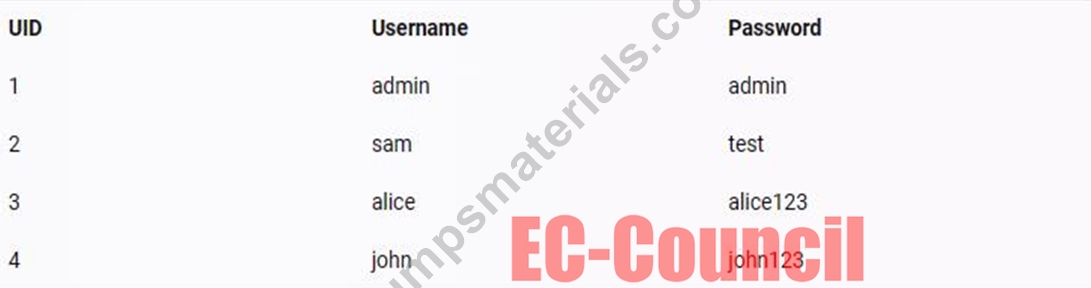
The UID that is mapped to user john is 4.
NEW QUESTION # 71
A software company is developing a new software product by following the best practices for secure application development. Dawson, a software analyst, is checking the performance of the application on the client's network to determine whether end users are facing any issues in accessing the application.
Which of the following tiers of a secure application development lifecycle involves checking the performance of the application?
- A. Quality assurance (QA)
- B. Development
- C. Staging
- D. Testing
Answer: D
NEW QUESTION # 72
......
Pass Your ECCouncil Exam with 212-82 Exam Dumps: https://braindumps2go.dumpsmaterials.com/212-82-real-torrent.html
