
Updated Mar-2026 Exam Engine for Databricks-Certified-Data-Engineer-Professional Exam Free Demo & 365 Day Updates
Exam Passing Guarantee Databricks-Certified-Data-Engineer-Professional Exam with Accurate Quastions!
NEW QUESTION # 25
Which statement describes integration testing?
- A. Requires an automated testing framework
- B. Validates behavior of individual elements of your application
- C. Validates an application use case
- D. Validates interactions between subsystems of your application
- E. Requires manual intervention
Answer: D
Explanation:
Integration testing is a type of software testing where components of the software are gradually integrated and then tested as a unified group.
Get Latest & Actual Certified-Data-Engineer-Professional Exam's Question and Answers from
NEW QUESTION # 26
A data organization has adopted Delta Sharing to securely distribute curated datasets from a Unity Catalog-enabled workspace. The data engineering team shares large Delta tables internally via Databricks-to-Databricks and externally via Open Sharing for aggregated reports. While testing, they encounter challenges related to access control, data update visibility, and shareable object types. What is a limitation of the Delta Sharing protocol or implementation when used with Databricks-to-Databricks or Open Sharing?
- A. With Databricks-to-Databricks sharing, Unity Catalog recipients must re-ingest data manually using COPY INTO or REST APIs.
- B. Delta Sharing does not support Unity Catalog-enabled tables; only legacy Hive Metastore tables are shareable.
- C. With Open Sharing, recipients cannot access Volumes, Models, or notebooks -- only static Delta tables are supported.
- D. Delta Sharing (both Databricks-to-Databricks and Open Sharing) allows recipients to modify the source data if they have select privileges.
Answer: C
Explanation:
According to Databricks' documentation, Open Sharing allows secure sharing of Delta tables to any recipient via a REST-based protocol without requiring a Databricks account. However, the Open Sharing protocol is limited to static Delta tables--it does not support sharing of Unity Catalog objects like Volumes, Machine Learning models, or notebooks. Only Databricks-to- Databricks sharing supports dynamic data sharing with update visibility and streaming reads.
Thus, the inability to share non-table objects in Open Sharing represents a known limitation of the protocol. Option A accurately reflects this constraint as described in Delta Sharing design principles and documentation.
NEW QUESTION # 27
A data engineer is brining an existing production Databricks job under asset bundle management and wants to ensure that:
- The job's current configuration is captured as YAML, and all
referenced files are included in their bundle project.
- Future changes to the bundle's YAML will update the existing job in-
place (not create a new job)
How should the data engineer successfully move the production job under asset bundle management?
- A. Run databricks bundle generate job --existing-job-id to generate the YAML and download referenced files. Then, run Databricks bundle deployment, bind to link the bundle's job resource to the existing job in Databricks.
- B. Run Databricks bundle generate job --existing-job-id to generate the YAML and download referenced files. Then, run Databricks bundle deploy to deploy the bundle, which will always update the existing job automatically.
- C. Export the job definition as JSON, convert it to YAML, and place it in your bundle. Then, run Databricks bundle deploy to update the existing job.
- D. Manually create the YAML configuration for the job in your bundle project, ensuring all settings match the existing job. Then, run Databricks bundle deploy the bundle, which will update the existing job in your workspace.
Answer: A
Explanation:
Generating the bundle from the existing job captures the full job configuration as YAML and pulls in all referenced files into the bundle project. Binding the generated job resource to the existing Databricks job establishes a persistent link, ensuring that future bundle deployments update the same production job in place rather than creating a new one.
NEW QUESTION # 28
A junior data engineer is working to implement logic for a Lakehouse table named silver_device_recordings. The source data contains 100 unique fields in a highly nested JSON structure.
The silver_device_recordings table will be used downstream to power several production monitoring dashboards and a production model. At present, 45 of the 100 fields are being used in at least one of these applications.
The data engineer is trying to determine the best approach for dealing with schema declaration given the highly-nested structure of the data and the numerous fields.
Which of the following accurately presents information about Delta Lake and Databricks that may impact their decision-making process?
- A. The Tungsten encoding used by Databricks is optimized for storing string data; newly-added native support for querying JSON strings means that string types are always most efficient.
- B. Schema inference and evolution on .Databricks ensure that inferred types will always accurately match the data types used by downstream systems.
- C. Human labor in writing code is the largest cost associated with data engineering workloads; as such, automating table declaration logic should be a priority in all migration workloads.
- D. Because Databricks will infer schema using types that allow all observed data to be processed, setting types manually provides greater assurance of data quality enforcement.
- E. Because Delta Lake uses Parquet for data storage, data types can be easily evolved by just modifying file footer information in place.
Answer: D
Explanation:
This is the correct answer because it accurately presents information about Delta Lake and Databricks that may impact the decision-making process of a junior data engineer who is trying to determine the best approach for dealing with schema declaration given the highly-nested structure of the data and the numerous fields. Delta Lake and Databricks support schema inference and evolution, which means that they can automatically infer the schema of a table from the source data and allow adding new columns or changing column types without affecting existing queries or pipelines. However, schema inference and evolution may not always be desirable or reliable, especially when dealing with complex or nested data structures or when enforcing data quality and consistency across different systems. Therefore, setting types manually can provide greater assurance of data quality enforcement and avoid potential errors or conflicts due to incompatible or unexpected data types.
NEW QUESTION # 29
Which statement describes Delta Lake Auto Compaction?
- A. Data is queued in a messaging bus instead of committing data directly to memory; all data is committed from the messaging bus in one batch once the job is complete.
- B. Optimized writes use logical partitions instead of directory partitions; because partition boundaries are only represented in metadata, fewer small files are written.
- C. Before a Jobs cluster terminates, optimize is executed on all tables modified during the most recent job.
- D. An asynchronous job runs after the write completes to detect if files could be further compacted; if yes, an optimize job is executed toward a default of 1 GB.
- E. An asynchronous job runs after the write completes to detect if files could be further compacted; if yes, an optimize job is executed toward a default of 128 MB.
Answer: E
Explanation:
This is the correct answer because it describes the behavior of Delta Lake Auto Compaction, which is a feature that automatically optimizes the layout of Delta Lake tables by coalescing small files into larger ones. Auto Compaction runs as an asynchronous job after a write to a table has succeeded and checks if files within a partition can be further compacted. If yes, it runs an optimize job with a default target file size of 128 MB. Auto Compaction only compacts files that have not been compacted previously.
NEW QUESTION # 30
The following table consists of items found in user carts within an e-commerce website.
Get Latest & Actual Certified-Data-Engineer-Professional Exam's Question and Answers from
The following MERGE statement is used to update this table using an updates view, with schema evaluation enabled on this table.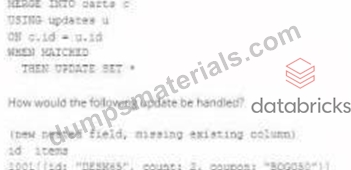
How would the following update be handled?
- A. The new nested field is added to the target schema, and files underlying existing records are updated to include NULL values for the new field.
- B. The update throws an error because changes to existing columns in the target schema are not supported.
- C. The update is moved to separate ''restored'' column because it is missing a column expected in the target schema.
- D. The new restored field is added to the target schema, and dynamically read as NULL for existing unmatched records.
Answer: A
Explanation:
With schema evolution enabled in Databricks Delta tables, when a new field is added to a record through a MERGE operation, Databricks automatically modifies the table schema to include the new field. In existing records where this new field is not present, Databricks will insert NULL values for that field. This ensures that the schema remains consistent across all records in the table, with the new field being present in every record, even if it is NULL for records that did not originally include it.
NEW QUESTION # 31
What is the first line of a Databricks Python notebook when viewed in a text editor?
- A. // Databricks notebook source
- B. # Databricks notebook source
- C. -- Databricks notebook source
- D. %python
- E. # MAGIC %python
Answer: B
Explanation:
https://docs.databricks.com/en/notebooks/notebook-export-import.html#import-a-file-and-convert- it-to-a-notebook
NEW QUESTION # 32
A data engineer needs to create an application that will collect information about the latest job run including the repair history. How should the data engineer format the request?
- A. Call/api/2.1/jobs/runs/get with the job_id and include_history parameters
- B. Call/api/2.1/jobs/runs/list with the job_id and include_history parameters
- C. Call/api/2.1/jobs/runs/get with the run_id and include_history parameters
- D. Call/api/2.1/jobs/runs/list with the run_id and include_history parameters
Answer: B
Explanation:
To retrieve information about the latest job runs along with their repair history, you use the jobs/runs/list endpoint with the job_id and include_history=true. This endpoint returns a list of runs for a specific job, including details about retries and repair attempts, which is not available via runs/get that retrieves a single run by run_id.
NEW QUESTION # 33
A data engineering team is setting up deployment automation. To deploy workspace assets remotely using the Databricks CLI command, they must configure it with proper authentication.
Which authentication approach will provide the highest level of security?
- A. Use a service principal ID and its OAuth client secret.
- B. Use a service principal and its Personal Access Token.
- C. Use a shared user account and its OAuth client secret.
- D. Use a service principal with OAuth token federation.
Answer: D
Explanation:
The most secure and enterprise-recommended authentication method for Databricks automation is OAuth token federation with service principals.
This configuration allows service principals (non-human identities) to authenticate using temporary OAuth access tokens from a trusted identity provider (such as Azure AD or AWS IAM federation). These tokens are short-lived and scoped, significantly reducing credential exposure risks.
By contrast, static client secrets (B) or PATs (C) are long-lived and require periodic manual rotation, increasing security vulnerability. Shared user accounts (D) violate least-privilege and auditability principles. Therefore, A provides the strongest, most compliant authentication model for automated CLI and CI/CD workflows.
NEW QUESTION # 34
A data engineer is optimizing a managed Delta table that suffers from data skew and frequently changing query filter columns. The engineer wants to avoid costly data rewrites when query patterns evolve. The table size is under 1 TB. How should the data engineer meet this requirement?
- A. Apply Z-ordering, since it allows flexible reorganization of data layout without rewriting existing files and adapts easily to new filter columns.
- B. Enable liquid clustering, as it efficiently handles data skew, allows clustering keys to be changed without rewriting existing data, and adapts to evolving query patterns.
- C. Use Hive-style partitioning, as it provides efficient data skipping and is easy to change partition columns at any time.
- D. Combine partitioning and Z-ordering to maximize flexibility and minimize maintenance as query patterns change.
Answer: B
Explanation:
Liquid clustering is designed for managed tables under 1TB with evolving query patterns. It efficiently addresses data skew, continuously optimizes data layout, and allows clustering keys to be changed without requiring full data rewrites, making it well suited for frequently changing filter columns while minimizing maintenance overhead.
NEW QUESTION # 35
The view updates represents an incremental batch of all newly ingested data to be inserted or updated in the customers table.
The following logic is used to process these records.
MERGE INTO customers
USING (
SELECT updates.customer_id as merge_ey, updates .*
FROM updates
UNION ALL
SELECT NULL as merge_key, updates .*
FROM updates JOIN customers
ON updates.customer_id = customers.customer_id
WHERE customers.current = true AND updates.address <> customers.address ) staged_updates ON customers.customer_id = mergekey WHEN MATCHED AND customers. current = true AND customers.address <> staged_updates.address THEN UPDATE SET current = false, end_date = staged_updates.effective_date WHEN NOT MATCHED THEN INSERT (customer_id, address, current, effective_date, end_date) VALUES (staged_updates.customer_id, staged_updates.address, true, staged_updates.effective_date, null) Which statement describes this implementation?
- A. The customers table is implemented as a Type 2 table; old values are overwritten and new customers are appended.
- B. The customers table is implemented as a Type 0 table; all writes are append only with no changes to existing values.
- C. The customers table is implemented as a Type 1 table; old values are overwritten by new values and no history is maintained.
- D. The customers table is implemented as a Type 2 table; old values are maintained but marked as no longer current and new values are inserted.
Answer: D
Explanation:
The provided MERGE statement is a classic implementation of a Type 2 SCD in a data warehousing context. In this approach, historical data is preserved by keeping old records (marking them as not current) and adding new records for changes. Specifically, when a match is found and there's a change in the address, the existing record in the customers table is updated to mark it as no longer current (current = false), and an end date is assigned (end_date = staged_updates.effective_date). A new record for the customer is then inserted with the updated information, marked as current. This method ensures that the full history of changes to customer information is maintained in the table, allowing for time-based analysis of customer data.
NEW QUESTION # 36
A developer has successfully configured credential for Databricks Repos and cloned a remote Git repository. Hey don not have privileges to make changes to the main branch, which is the only branch currently visible in their workspace.
Use Response to pull changes from the remote Git repository commit and push changes to a branch that appeared as a changes were pulled.
- A. Use repos to merge all difference and make a pull request back to the remote repository.
- B. Use Repos to pull changes from the remote Git repository; commit and push changes to a branch that appeared as changes were pulled.
- C. Use repos to create a fork of the remote repository commit all changes and make a pull request on the source repository
- D. Use Repos to merge all differences and make a pull request back to the remote repository.
- E. Use Repos to create a new branch commit all changes and push changes to the remote Git repertory.
Get Latest & Actual Certified-Data-Engineer-Professional Exam's Question and Answers from
Answer: E
Explanation:
In Databricks Repos, when a user does not have privileges to make changes directly to the main branch of a cloned remote Git repository, the recommended approach is to create a new branch within the Databricks workspace. The developer can then make changes in this new branch, commit those changes, and push the new branch to the remote Git repository. This workflow allows for isolated development without affecting the main branch, enabling the developer to propose changes via a pull request from the new branch to the main branch in the remote repository. This method adheres to common Git collaboration workflows, fostering code review and collaboration while ensuring the integrity of the main branch.
NEW QUESTION # 37
A company wants to implement Lakehouse Federation across multiple data sources but is concerned about data consistency and ensuring that all teams access the same authoritative version of their data. Which statement is applicable for Lakehouse Federations to maintain data consistency?
- A. Federation implements change data capture (CDC) from all sources.
- B. Federation provides read-only access that reflects the current state of source systems.
- C. Federation creates local copies that must be manually refreshed.
- D. A separate data synchronization service must be deployed.
Answer: B
Explanation:
Lakehouse Federation allows Databricks to query and manage external data sources through a single governance layer, without moving or copying data. The documentation specifies that
"Federated queries provide read-only access to data, reflecting the current state of the underlying source system." This ensures consistency across teams since all users access the same source of truth directly from the external system through Unity Catalog. Federation does not perform CDC replication or local caching; it queries live data on demand. Hence, option A accurately represents how Lakehouse Federation maintains consistency across federated sources.
NEW QUESTION # 38
Which statement describes Delta Lake Auto Compaction?
- A. Data is queued in a messaging bus instead of committing data directly to memory; all data is committed from the messaging bus in one batch once the job is complete.
- B. Optimized writes use logical partitions instead of directory partitions; because partition boundaries are only represented in metadata, fewer small files are written.
- C. An asynchronous job runs after the write completes to detect if files could be further compacted; if yes, an optimize job is executed toward a default of 1 GB.
- D. Before a Jobs cluster terminates, optimize is executed on all tables modified during the most recent job.
Get Latest & Actual Certified-Data-Engineer-Professional Exam's Question and Answers from - E. An asynchronous job runs after the write completes to detect if files could be further compacted; if yes, an optimize job is executed toward a default of 128 MB.
Answer: E
Explanation:
This is the correct answer because it describes the behavior of Delta Lake Auto Compaction, which is a feature that automatically optimizes the layout of Delta Lake tables by coalescing small files into larger ones. Auto Compaction runs as an asynchronous job after a write to a table has succeeded and checks if files within a partition can be further compacted. If yes, it runs an optimize job with a default target file size of 128 MB. Auto Compaction only compacts files that have not been compacted previously.
NEW QUESTION # 39
A data engineer is setting up a pipeline to ingest data from a message bus system that occasionally delivers duplicate messages. The duplicate messages can be a week apart. The target is a Databricks Delta Lake table where each record should appear exactly once. Which Databricks ingestion pattern should be implemented to handle potential duplicates where events can arrive outside of the configured watermark?
- A. Use Delta Lake's change data feed to filter duplicate records
- B. Configure Structured Streaming with dropDuplicates transformation
- C. Implement a write operation using MERGE INTO with a unique key
- D. Use Delta Lake time travel to identify and remove duplicates
Answer: C
Explanation:
Using MERGE INTO with a unique key enforces idempotent writes at the Delta Lake table level.
This approach reliably handles duplicates even when events arrive far outside any streaming watermark, ensuring that each logical record is written exactly once regardless of arrival time.
NEW QUESTION # 40
The Databricks workspace administrator has configured interactive clusters for each of the data engineering groups. To control costs, clusters are set to terminate after 30 minutes of inactivity.
Each user should be able to execute workloads against their assigned clusters at any time of the day.
Assuming users have been added to a workspace but not granted any permissions, which of the following describes the minimal permissions a user would need to start and attach to an already configured cluster.
- A. Workspace Admin privileges, cluster creation allowed. "Can Attach To" privileges on the required cluster
- B. "Can Manage" privileges on the required cluster
- C. Cluster creation allowed. "Can Attach To" privileges on the required cluster
- D. "Can Restart" privileges on the required cluster
- E. Cluster creation allowed. "Can Restart" privileges on the required cluster
Answer: D
Explanation:
https://learn.microsoft.com/en-us/azure/databricks/security/auth-authz/access-control/cluster-acl
https://docs.databricks.com/en/security/auth-authz/access-control/cluster-acl.html Get Latest & Actual Certified-Data-Engineer-Professional Exam's Question and Answers from
NEW QUESTION # 41
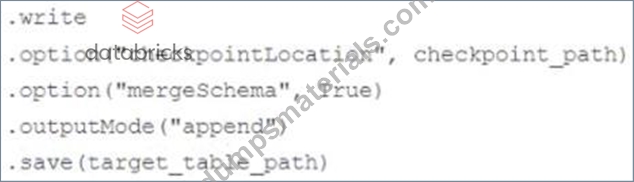
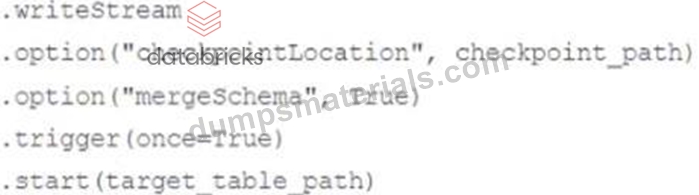
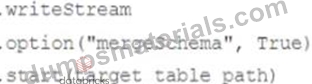
In order to facilitate near real-time workloads, a data engineer is creating a helper function to leverage the schema detection and evolution functionality of Databricks Auto Loader. The desired function will automatically detect the schema of the source directly, incrementally process JSON files as they arrive in a source directory, and automatically evolve the schema of the table when new fields are detected.
The function is displayed below with a blank:
Which response correctly fills in the blank to meet the specified requirements?
- A.
- B.
- C.
- D.

- E.
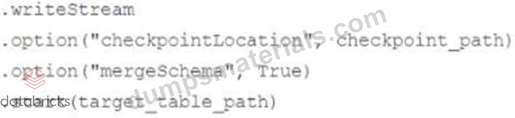
Answer: E
Explanation:
https://docs.databricks.com/en/ingestion/auto-loader/schema.html
NEW QUESTION # 42
A data governance team at a large enterprise is improving data discoverability across its organization. The team has hundreds of tables in their Databricks Lakehouse with thousands of columns that lack proper documentation. Many of these tables were created by different teams over several years, with missing context about column meanings and business logic. The data governance team needs to quickly generate comprehensive column descriptions for all existing tables to meet compliance requirements and improve data literacy across the organization. They want to leverage modern capabilities to automatically generate meaningful descriptions rather than manually documenting each column, which would take months to complete. Which approach should the team use in Databricks to automatically generate column comments and descriptions for existing tables?
- A. Use Delta Lake's DESCRIBE HISTORY command to analyze table evolution and infer column purposes from historical changes.
- B. Write custom PySpark code using df.describe() and df.schema to programmatically generate basic statistical descriptions for each column.
- C. Navigate to the table in Databricks Catalog Explorer, select the table schema view, and use the AI Generate option which leverages artificial intelligence to automatically create meaningful column descriptions based on column names, data types, sample values, and data patterns.
- D. Use the DESCRIBE TABLE command to extract existing schema information and manually write descriptions based on column names and data types.
Answer: C
Explanation:
The Catalog Explorer provides an AI-powered "AI Generate" capability that automatically creates intelligent column descriptions by analyzing column names, data types, sample values, and observed data patterns. This approach enables rapid, scalable documentation of existing tables, significantly improving data discoverability and compliance without manual effort.
NEW QUESTION # 43
A data engineer is designing a pipeline in Databricks that processes records from a Kafka stream where late-arriving data is common. Which approach should the data engineer use?
- A. Use an Auto CDC pipeline with batch tables to simplify late data handling.
- B. Use a watermark to specify the allowed lateness to accommodate records that arrive after their expected window, ensuring correct aggregation and state management.
- C. Use batch processing and overwrite the entire output table each time to ensure late data is incorporated correctly.
- D. Implement a custom solution using Databricks Jobs to periodically reprocess all historical data.
Answer: B
Explanation:
In Structured Streaming, event-time watermarks control how long the engine waits for late- arriving data before finalizing aggregations. By setting an appropriate watermark, Databricks can handle late data gracefully -- incorporating records that arrive within the defined window while discarding excessively delayed events.
This approach ensures accurate aggregations, minimizes state size, and prevents memory leaks.
Manual reprocessing (A) or overwriting entire datasets (B) is inefficient and costly, while Auto CDC (C) is used for change tracking in Delta tables, not for streaming event lateness.
Thus, using watermarking is the recommended and official approach for managing late data in streaming pipelines.
NEW QUESTION # 44
A data architect has heard about lake's built-in versioning and time travel capabilities. For auditing purposes they have a requirement to maintain a full of all valid street addresses as they appear in the customers table.
The architect is interested in implementing a Type 1 table, overwriting existing records with new values and relying on Delta Lake time travel to support long-term auditing. A data engineer on the project feels that a Type 2 table will provide better performance and scalability. Which piece of Get Latest & Actual Certified-Data-Engineer-Professional Exam's Question and Answers from information is critical to this decision?
- A. Delta Lake time travel does not scale well in cost or latency to provide a long-term versioning solution.
- B. Delta Lake time travel cannot be used to query previous versions of these tables because Type 1 changes modify data files in place.
- C. Shallow clones can be combined with Type 1 tables to accelerate historic queries for long-term versioning.
- D. Delta Lake only supports Type 0 tables; once records are inserted to a Delta Lake table, they cannot be modified.
- E. Data corruption can occur if a query fails in a partially completed state because Type 2 tables requires setting multiple fields in a single update.
Answer: A
Explanation:
Delta Lake's time travel feature allows users to access previous versions of a table, providing a powerful tool for auditing and versioning. However, using time travel as a long-term versioning solution for auditing purposes can be less optimal in terms of cost and performance, especially as the volume of data and the number of versions grow. For maintaining a full history of valid street addresses as they appear in a customers table, using a Type 2 table (where each update creates a new record with versioning) might provide better scalability and performance by avoiding the overhead associated with accessing older versions of a large table. While Type 1 tables, where existing records are overwritten with new values, seem simpler and can leverage time travel for auditing, the critical piece of information is that time travel might not scale well in cost or latency for long-term versioning needs, making a Type 2 approach more viable for performance and scalability.
NEW QUESTION # 45
A junior data engineer has manually configured a series of jobs using the Databricks Jobs UI.
Upon reviewing their work, the engineer realizes that they are listed as the "Owner" for each job.
They attempt to transfer "Owner" privileges to the "DevOps" group, but cannot successfully accomplish this task.
Which statement explains what is preventing this privilege transfer?
- A. The creator of a Databricks job will always have "Owner" privileges; this configuration cannot be changed.
- B. Other than the default "admins" group, only individual users can be granted privileges on jobs.
- C. Only workspace administrators can grant "Owner" privileges to a group.
- D. Databricks jobs must have exactly one owner; "Owner" privileges cannot be assigned to a group.
- E. A user can only transfer job ownership to a group if they are also a member of that group.
Answer: D
Explanation:
A job cannot have more than one owner. A job cannot have a group as an owner.
NEW QUESTION # 46
A data engineer is working in an interactive notebook with many transformations before outputting the result from display(df.collect() ). The notebook includes wide transformations and a cross join.
The data engineer is getting the following error: "The spark driver has stopped unexpectedly and is restarting. Your notebook will be automatically reattached." Which action should the data engineer take?
- A. Check into the Spark UI to see how many jobs are assigned to each stage as they are employing fewer executors.
- B. Rewrite their code to avoid putting memory pressure on the driver node.
- C. Look at the compute metrics UI to see if the executors have higher than 90% memory utilization.
- D. Run the notebook on a single node cluster to keep driver from falling.
Answer: B
Explanation:
Calling df.collect() on a large DataFrame forces all data to be loaded into the driver's memory.
With wide transformations and a cross join, this can easily exceed the driver's capacity, causing it to crash. The data engineer should rewrite the code to avoid collecting large datasets on the driver, using operations like display(df) or writing to storage instead.
NEW QUESTION # 47
A production workload incrementally applies updates from an external Change Data Capture feed to a Delta Lake table as an always-on Structured Stream job. When data was initially migrated for this table, OPTIMIZE was executed and most data files were resized to 1 GB. Auto Optimize and Auto Compaction were both turned on for the streaming production job. Recent review of data files shows that most data files are under 64 MB, although each partition in the table contains at least 1 GB of data and the total table size is over 10 TB.
Which of the following likely explains these smaller file sizes?
- A. Databricks has autotuned to a smaller target file size to reduce duration of MERGE operations
- B. Z-order indices calculated on the table are preventing file compaction C Bloom filler indices calculated on the table are preventing file compaction
- C. Databricks has autotuned to a smaller target file size based on the overall size of data in the table
- D. Databricks has autotuned to a smaller target file size based on the amount of data in each partition
Answer: A
Explanation:
This is the correct answer because Databricks has a feature called Auto Optimize, which automatically optimizes the layout of Delta Lake tables by coalescing small files into larger ones and sorting data within each file by a specified column. However, Auto Optimize also considers the trade- off between file size and merge performance, and may choose a smaller target file size to reduce the duration of merge operations, especially for streaming workloads that frequently update existing records. Therefore, it is possible that Auto Optimize has autotuned to a smaller target file size based on the characteristics of the streaming production job.
NEW QUESTION # 48
A Delta Lake table representing metadata about content from user has the following schema:
Based on the above schema, which column is a good candidate for partitioning the Delta Table?
- A. latitude
- B. Date
- C. Post_time
- D. User_id
- E. Post_id
Answer: B
Explanation:
Partitioning a Delta Lake table improves query performance by organizing data into partitions based on the values of a column. In the given schema, the date column is a good candidate for partitioning for several reasons:
Time-Based Queries: If queries frequently filter or group by date, partitioning by the date column can significantly improve performance by limiting the amount of data scanned. Granularity: The date column likely has a granularity that leads to a reasonable number of partitions (not too many and not too few). This balance is important for optimizing both read and write performance.
Data Skew: Other columns like post_id or user_id might lead to uneven partition sizes (data skew), which can negatively impact performance.
Get Latest & Actual Certified-Data-Engineer-Professional Exam's Question and Answers from Partitioning by post_time could also be considered, but typically date is preferred due to its more manageable granularity.
NEW QUESTION # 49
A data engineer is building a streaming data pipeline to ingest JSON files from cloud storage into a Delta Lake table. The pipeline must process files incrementally, handle schema evolution automatically, ensure exactly-once processing, and minimize manual infrastructure management.
How should the data engineer fulfill these requirements?
- A. Use Auto Loader in batch mode with a daily job to overwrite the Delta table.
- B. Use Lakeflow Spark Declarative Pipelines with a static DataFrame read, merge schema with spark.conf.set ("spark.databricks.delta.schema.autoMerge.enabled", "true")
- C. Use Lakeflow Spart Declarative Pipelines with Auto Loader and enabling schema inference with
"cloudFiles.schemaEvolutionMode"= "addNewColumns" - D. Use traditional Spark Structured Streaming with Auto Loader, manually configuring checkpoints location and enabling schema inference with "mergeSchema"= "true"
Answer: C
Explanation:
Lakeflow Spark Declarative Pipelines combined with Auto Loader provide fully managed incremental file ingestion with exactly-once guarantees and minimal operational overhead.
Enabling schema inference and evolution allows new columns in incoming JSON files to be incorporated automatically, satisfying the requirements for streaming ingestion, schema evolution, and reduced manual infrastructure management.
NEW QUESTION # 50
......
Exam Questions for Databricks-Certified-Data-Engineer-Professional Updated Versions With Test Engine: https://braindumps2go.dumpsmaterials.com/Databricks-Certified-Data-Engineer-Professional-real-torrent.html
